

Prop firm education
Static versus trailing drawdown: compare the rule, not just the account size
Compare static and trailing drawdown using Topstep and FTMO examples, then check daily limits, account phases and the full evaluation cost.
Originally published
- Originally published
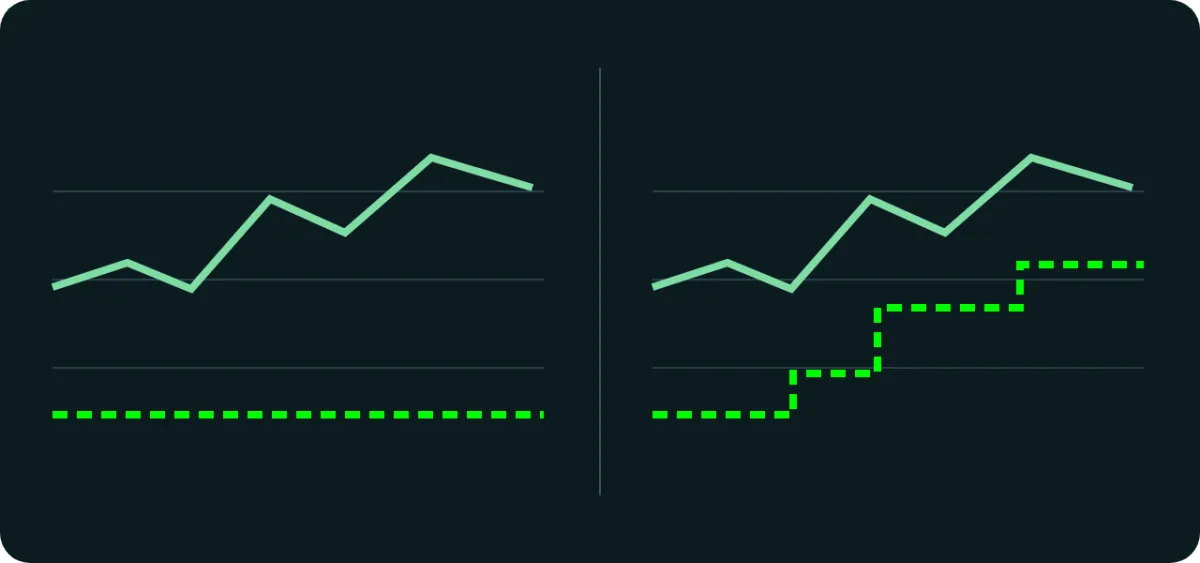
Two trading evaluations can advertise a similar account size while allowing very different room for losses. To compare them, start with the loss floor: the equity threshold used by the programme's loss rule. Whether touching or crossing it is a breach depends on the rule. Then ask when that floor changes and whether open-position losses count.
A static overall loss floor stays tied to the initial account size. FTMO's CFD 2-Step programme sets maximum loss at 10% of initial simulated capital. In a $100,000 example, the overall floor is $90,000. A separate daily limit applies, so staying above the overall floor alone does not establish compliance. Read the 2-Step trading objectives for the current definitions and calculation time.
A trailing floor moves upward under the programme's stated rule. Topstep's standard 50K Trading Combine starts with a $2,000 maximum loss limit. If the end-of-day balance rises from $50,000 to $50,500, its floor moves from $48,000 to $48,500. Giving back the $500 gain does not move that floor down again. The floor locks when it reaches the starting balance. Topstep monitors breaches during the session, including unrealized losses; end-of-day adjustment does not mean losses only matter at the close. See its Maximum Loss Limit explanation.
These examples illustrate different mechanics, not equivalent products or a recommendation to purchase either programme. A useful comparison keeps the exact programme and account phase attached to every rule. An evaluation, simulated funded stage and live account can have different conditions even when they share a brand name.
Before choosing an evaluation, record five things beside the advertised size: the initial loss allowance, what moves the floor, when it is checked, the separate daily rule and what changes after a withdrawal. Then compare the full cost of reaching and maintaining the intended stage: evaluation charges, recurring fees, resets, activation, data/platform charges and applicable taxes. A headline discount is not a total-cost calculation.
Use BullTraders' comparison tool to narrow the programmes you want to investigate, then check the provider's current rules and the observation dates attached to the comparison. Fees, payout eligibility and programme variations need their own current source check; a drawdown example does not settle them.