

Hantec Trader Review
Hantec Trader review covering simulated prop accounts, instant-account rules, payout conditions and the limits of available payout evidence.
Review text updated September 13, 2026
Review method: published documents. The text update does not reverify every programme rule.
View tracked accounts and dated terms. Comparison coverage includes only the providers and plans currently collected.
Who is Hantec Trader
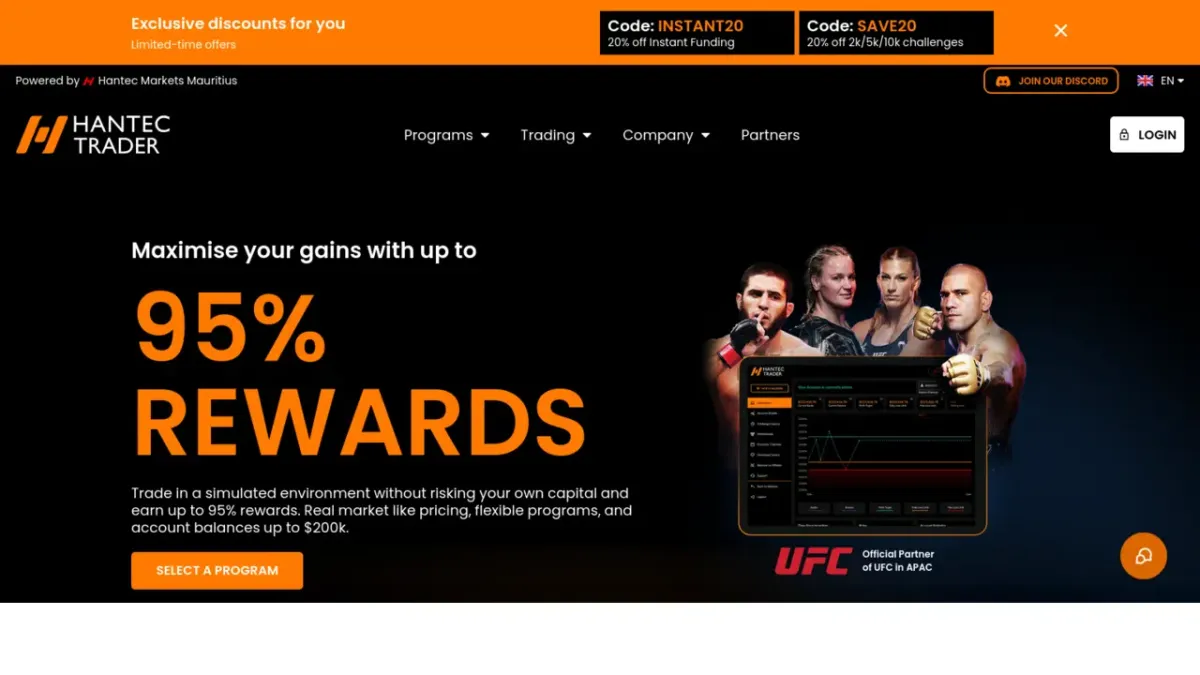
Hantec Trader is the prop-trading product attached to the wider Hantec Markets brand. Its public site says the service is powered by Hantec Markets Mauritius and offers traders simulated accounts with real market-like pricing, account balances up to $200k, and rewards based on virtual profits.
The important point is the account model. Hantec Trader is a simulated prop firm, not a route to trading firm capital in a live brokerage account under your own name. The trader buys a challenge or an instant-style program, trades under the program rules, completes KYC where required, and may then receive rewards calculated from simulated profit.
The range is broad. The public program selector showed instant programs, a one-step Express program, two-step Enhanced and EnhancedX options, and a three-step Endurance path. That gives Hantec Trader more menu depth than a single-model shop, although it also means the rule set changes materially depending on the program selected.
At a glance
The trade-off is rule complexity. The instant products in particular carry tight limits on open risk, open positions, consistency and automation. A trader who treats the headline reward split as the whole offer can easily miss the conditions that decide whether a reward request is approved.
The cleanest read is this: Hantec Trader is worth researching for disciplined traders who want a broker-backed simulated environment and who are willing to trade within a precise rule book. It is a poor fit for high-frequency EA users, aggressive news scalpers on instant accounts, or anyone who opens challenges first and reads denial rules later.
Eligibility and who can use it
Hantec Trader says traders must be over the age of eighteen and outside restricted countries. The FAQ states that if a country is missing during the personal-information stage of purchase, it should be treated as restricted.
There are additional product-level restrictions. The homepage stated that instant programs are unavailable to residents of the UK, Mauritius, Hong Kong and Singapore. That restriction matters because traders often compare instant and challenge accounts as if they are interchangeable. For some jurisdictions they are simply unavailable.
Funded-stage access also requires the administrative steps. The FAQ says a trader becomes a contractor after completing KYC and signing the contractor agreement. That means passing a challenge is only one part of the process. Identity verification and contract acceptance remain part of the payout path.
Firm safety and trust
Hantec Trader benefits from a stronger brand wrapper than many young prop firms. The site says it is powered by Hantec Markets Mauritius, and it leans on the wider Hantec Group's long operating history in financial markets. That is a meaningful positive for context, because many prop firms are thin standalone marketing brands with little institutional history.
That said, the safety question is still specific to the prop product. Hantec Trader accounts are simulated accounts, and the trader relationship is described as a contractor arrangement after KYC and agreement signing. Prop-firm rewards depend on the firm's commercial policy, risk controls and continued willingness to pay valid claims.
Trading conditions and execution
Hantec Trader advertises real market-like pricing in a simulated environment. The homepage says execution is powered by Hantec Markets Mauritius, and the platform section refers to real-time data, advanced tools, fast execution and expert-adviser capability on the trading platforms.
That language is encouraging, but traders should keep the distinction clear. A simulated prop account can mirror market conditions closely while still being governed by a private rule book, challenge logic and payout review process. Execution quality matters, yet rule compliance matters just as much.
The program mix also affects trading style. Express and Enhanced-style accounts appear more flexible for ordinary discretionary trading, while Instant 24 is much more constrained. The best execution environment for a trader is therefore the one whose rule set matches the way that trader actually manages risk.
Rules and restrictions (drawdown + what gets you banned)
Hantec Trader's public rules are detailed, which is positive. They also require careful reading. The FAQ defines a hard breach as violating the maximum daily loss or maximum total loss rule, which leads to failing the challenge or closure of the Hantec Trader account.
Drawdown differs by program. The FAQ says Enhanced uses a static maximum total loss from the initial balance, EnhancedX and Endurance use their own static limits, and Express uses a closed-balance trailing model that stops trailing after sufficient profit and locks at starting balance. Instant 24 uses an even tighter structure, with a short trading window, low daily loss, low total loss and trailing drawdown.
The restrictions that matter most are the ones that can surprise traders. Instant 24 prohibits EAs and robots, allows only one open position at a time, limits maximum open risk, and applies a trade-consistency rule before rewards. The rules page also treats some repeated same-direction entries as the same trade idea for open-risk purposes. These are operational rules, not fine print.
Plans and cost
The pricing structure is a one-time program-fee model, with costs changing by account size, challenge path and add-ons. The smallest instant accounts sit at the low end, while larger one-step, two-step and three-step programs move up with simulated balance size.
The public site also shows add-ons that can affect the reward split or payout timing. That creates a menu where the cheapest visible option may not be the same as the most practical option for a given trading style.
The comparison tool shows dated evidence for covered accounts. Confirm the exact plan, availability and checkout terms with the provider. Fees, add-ons and availability change often enough that a static review is the wrong place to anchor a buying decision.
Payouts and how they get denied
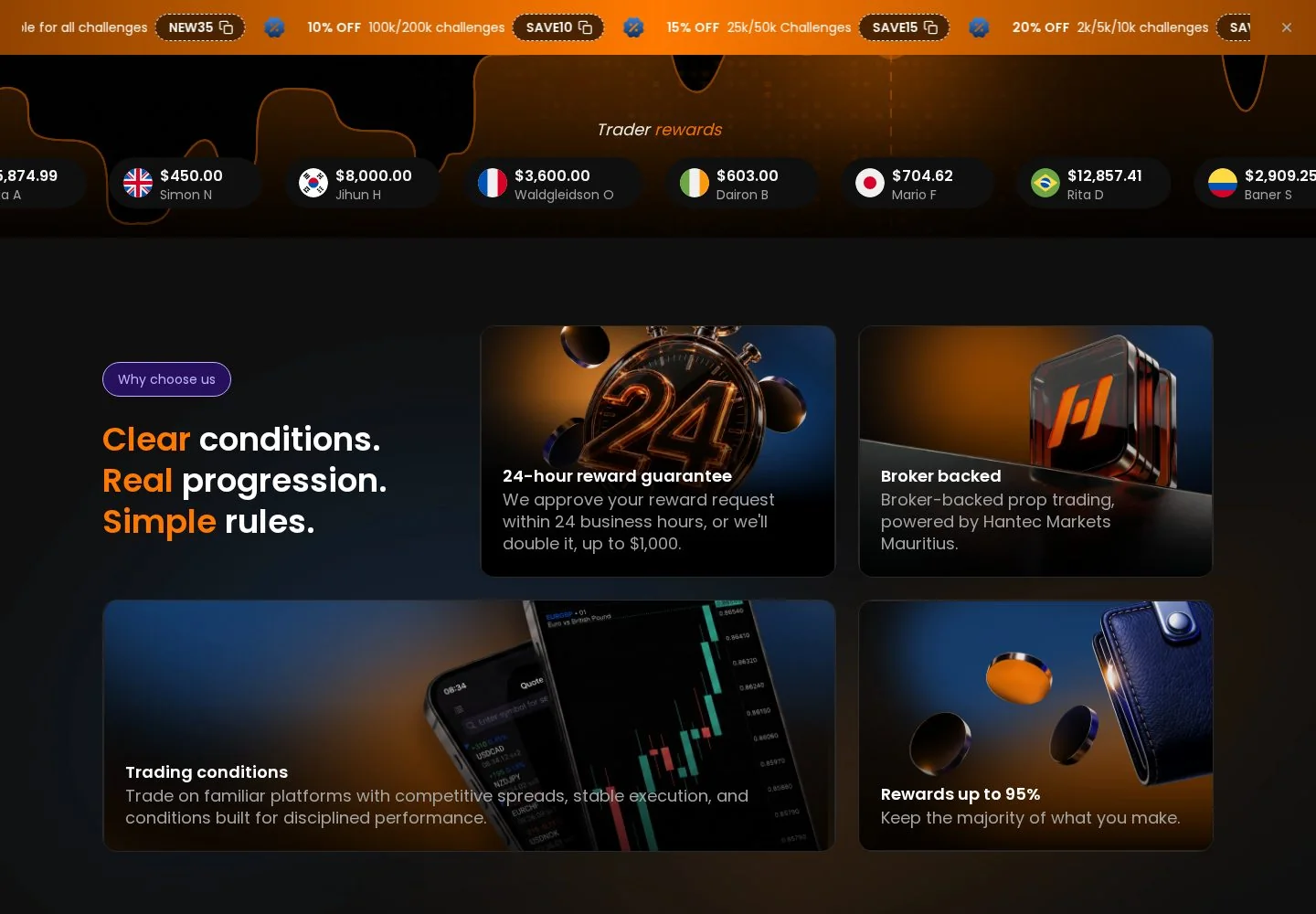
An earlier third-party snapshot reported tracked payouts and waiting times, but it does not establish a current typical withdrawal time or an audited payout total. The homepage also advertised a business-hours reward guarantee; check its current eligibility, exclusions and compensation terms. Marketing about approval speed is not a guarantee that every profitable account qualifies for payment.
The denial risk sits in rule compliance. Rewards can be blocked or delayed by hard breaches, minimum profit thresholds, consistency failures, KYC issues, contract issues, prohibited automation, open-risk breaches or trading outside product-specific limits. Instant 24 is the highest-attention product here because a trader can make money and still fail the reward review if one trade is too large relative to total profit or if risk rules are breached intraday.
Traders should document their own rule compliance before requesting a reward. Check daily loss, total loss, best-trade concentration, open-risk history, prohibited strategy rules, minimum profit and KYC status. A compliant account still needs the applicable approval and payment process; this review does not establish a current processing-time benchmark. The practical risk is reaching profit through a route the rule book does not reward.
Scaling and longevity
The FAQ references scaling and says traders may start with the virtual balance of the last successfully completed challenge if they scaled on the way to receiving a Hantec Trader account. That confirms the existence of a progression concept, although the public snapshot available during this review gave less detail on long-term scaling mechanics than on core challenge rules.
Longevity is more promising than the average new prop brand because the Hantec name has broader market history. PropFirmMatch listed Hantec Trader as created in late twenty twenty-three, so the prop product itself remains relatively young.
For a trader, the sensible view is balanced. Hantec Trader has better brand context and payout visibility than many newer firms, while its long-term prop-program record is still developing.
Limitations
- Instant 24 has tighter operating constraints, including restrictions on robots, simultaneous positions, open risk and trade consistency.
- Drawdown models differ across programmes, and repeated entries can count as one trade idea for risk limits. Treating each ticket as an independent allowance can misrepresent the permitted risk.
Who it suits
Hantec Trader is best for traders who already trade with defined risk per trade, keep clean records, and want fast payout processing if they meet the rules. It is also suited to traders who value a broker-associated brand more than a purely anonymous prop-firm operation.
It is suited to discretionary forex and CFD-style traders who can adapt to program-specific limits. The one-step and two-step paths appear more natural for conventional challenge traders than the strictest instant product.
It is unsuitable for traders who rely on prohibited EAs in instant accounts, stack multiple correlated positions, push open drawdown aggressively, or expect a single large win to carry a reward request. It is also a weak fit for traders who dislike reading rule pages before paying.
Our verdict
The caution is rule-driven. This is a simulated-account rewards business with program-specific limits, and some of those limits are strict. The instant products in particular reward precision and punish improvisation.
FAQ
Is Hantec Trader a live funded account?
Hantec Trader describes its accounts as simulated. Traders receive rewards based on virtual profits after meeting program rules and completing the required process.
Does Hantec Trader pay quickly?
This review does not establish a current typical withdrawal time. The earlier third-party snapshot and advertised reward guarantee do not measure every eligible trader’s experience. Approval depends on the exact product rules, identity and contract checks, and any review of trading activity; advertised approval speed should not be treated as a guaranteed payment-arrival time.
What is the main payout-denial risk?
The main risk is rule compliance. Hard breaches, consistency failures, minimum-profit issues, prohibited automation, open-risk breaches, KYC problems or contract issues can all affect reward eligibility.
Can I use EAs or robots?
That depends on the program. The Instant 24 rules reviewed here explicitly prohibit automated trading software, bots and Expert Advisors. Check the rule page for the exact program before buying.
Who cannot use Hantec Trader?
The FAQ says traders must be adults and outside restricted countries. The homepage also stated that instant programs are unavailable to residents of the UK, Mauritius, Hong Kong and Singapore.
Should I choose instant or a challenge account?
Choose based on rule fit. Instant access is appealing, but the instant rule set is tighter. Traders who need more normal risk management may prefer a challenge path with conditions that match their actual trading behavior.
Provider documentation
Hantec Trader official website contains the provider's product pages and legal terms. Match the account, plan and country before applying a rule or advertised price.
Compare tracked prop firm accounts for account fees, rules and payout terms. Not every reviewed firm has accounts in the comparison.