

Wall Street Funded Review
Wall Street Funded review covering rules, payouts, account models, trader feedback, safety, platforms and who should avoid this prop firm.
Review text updated September 13, 2026
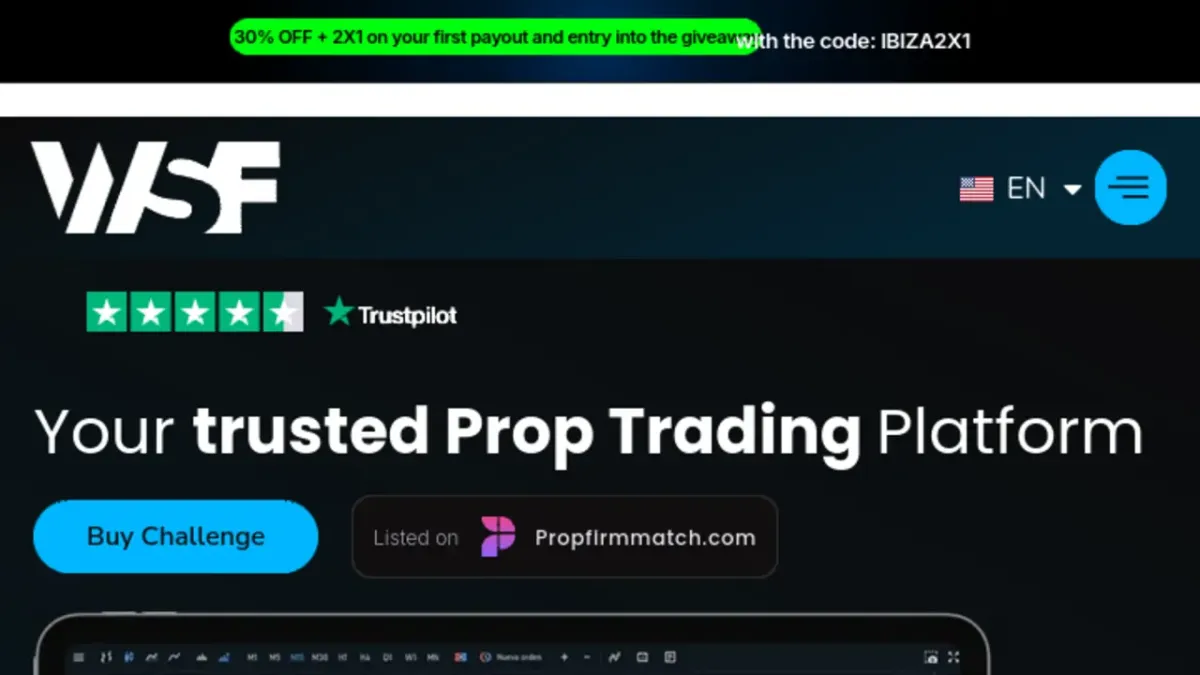
Review method: published documents. The text update does not reverify every programme rule.
View tracked accounts and dated terms. Comparison coverage includes only the providers and plans currently collected.
Who is Wall Street Funded
This review covers the forex and CFD-style simulated challenge described on WSFunded's website. It should be compared with the same kind of evaluation rather than futures-only programmes.
Wall Street Funded, usually branded as WSFunded, is a forex and CFD-style prop trading challenge provider. Its own footer describes the product as a simulated trading environment: traders receive demo credentials and any displayed balance, profit or loss is hypothetical inside the firm's platform setup.
The account menu is broad. The homepage shows instant, one-step and two-step routes, with Pro and Standard variants. The FAQ names Rapid as a one-phase evaluation, Classic and Ultra as two-phase evaluations, and separate instant-style products. The firm says traders can use MetaTrader 5, Match-Trader and cTrader.
This is best understood as a challenge and simulated funded-account business rather than a broker or money manager. The company says it does not hold client funds, manage client money or provide access to regulated financial instruments.
At a glance
Wall Street Funded looks stronger on rule disclosure than many newer prop firms. Its FAQ publishes account objectives, drawdown mechanics, payout timing, platform access, banned strategies, entity information and restricted countries. The main positive case is simple: static drawdown on the flagship evaluation path, multiple platforms, visible payout process details and generally positive public review sentiment.
The caution is equally clear. The accounts are simulated, the corporate setup spans Saint Lucia, Dubai and a Cyprus payment entity, and the firm operates outside the investor-protection framework a trader would expect from a regulated broker. The rulebook also contains broad strategy bans and a strict stop-loss timing requirement. Traders who need maximum regulatory comfort or who trade ultra-short-duration execution styles should be careful.
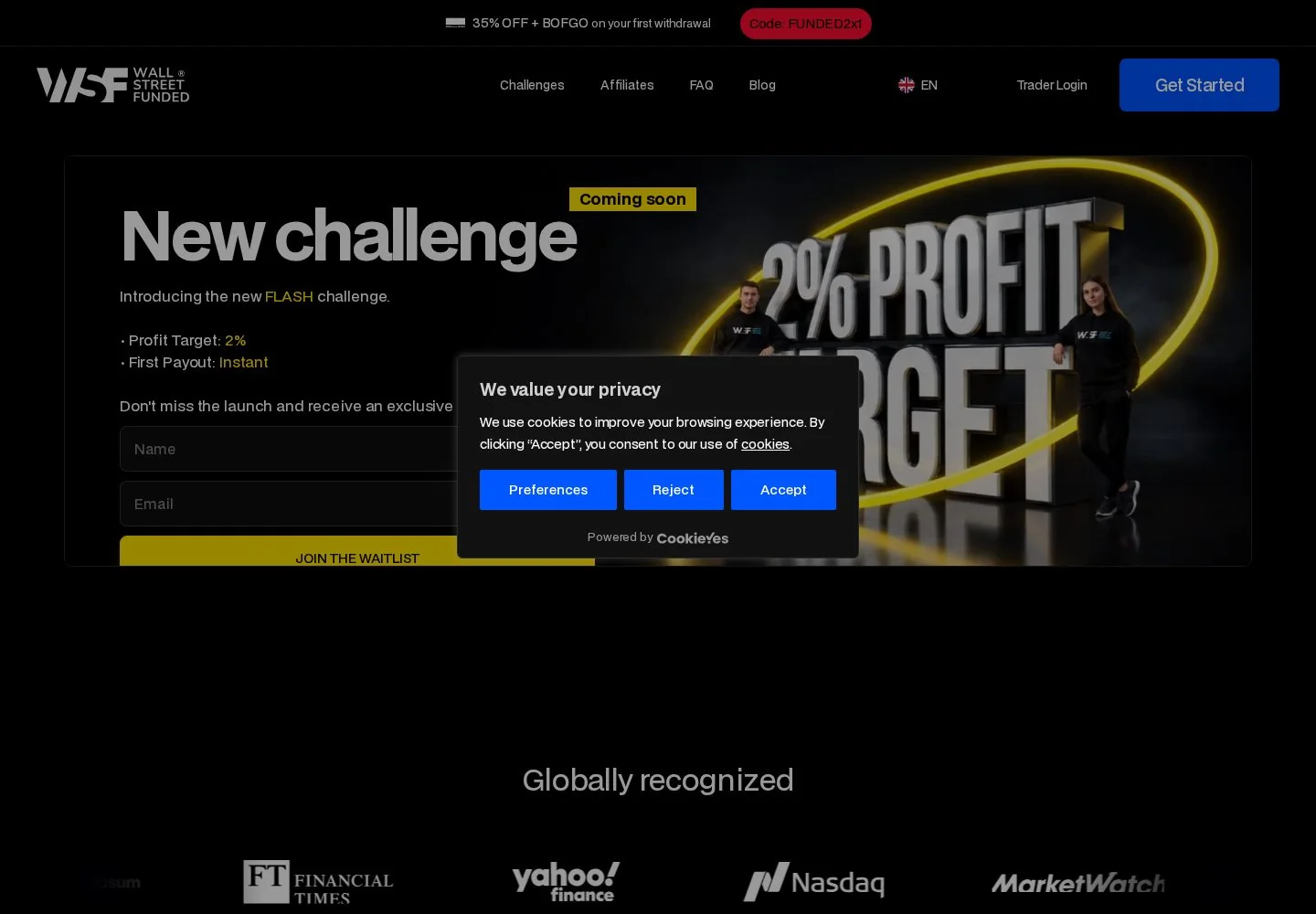
Eligibility and who can use it
Wall Street Funded says users must be adults. Its regional restrictions exclude residents of several jurisdictions, including the United States, Singapore, Russia and the United Arab Emirates, plus sanctioned and FATF-listed jurisdictions. That matters because the public contact details place the brand's operating presence in Dubai, while the website still says UAE residents are restricted.
The practical eligibility screen is therefore simple: check your country before considering any plan. If you live in a restricted market, the review ends there. If you are eligible, the next question is whether your strategy fits the rulebook, because prohibited execution styles can lead to immediate account closure.
Firm safety and trust
Those disclosures help, but they do not remove the main safety limitation. The firm says its accounts are demo accounts with fictitious funds, and that it does not hold client funds or provide regulated financial instruments. In other words, trader protection comes from the contract and the firm's willingness to honor it, rather than from brokerage regulation or client-money safeguarding.
That makes payout history and rule clarity the trust anchors. On those points the public evidence is encouraging, although still mostly review-platform evidence rather than audited financial evidence.
Trading conditions and execution
Wall Street Funded supports MetaTrader 5, Match-Trader and cTrader, and the homepage publishes demo login credentials for checking platform conditions. The firm says its environment uses real-time data and institutional liquidity, while its legal language still frames all trading as simulated.
That distinction matters. Traders are evaluating spreads, slippage and fills inside the firm's selected platform and liquidity setup, rather than receiving a direct brokerage account in their own name. The homepage claims cTrader is suited to scalpers and day traders, but the FAQ bans several short-duration and execution-arbitrage styles. Scalpers should read the strategy restrictions before relying on platform marketing.
The public record contains positive comments about trading conditions, especially on PropFirmMatch, but the visible evidence remains review-based. Serious traders should test the demo credentials, compare spreads during their usual session and confirm commissions before buying.
Rules and restrictions
The rulebook is reasonably explicit. Classic, the two-phase model, requires a first target followed by a smaller second target, has minimum trading days, no maximum time, daily drawdown, static maximum drawdown, a risk cap per trading idea, an inactivity period, EA allowance and payout timing. Rapid, the one-phase model, has a higher single target and a tighter static drawdown.
The main restriction to notice is the stop-loss rule. The FAQ says all trades must have a stop loss added within a short window after opening. That can be manageable for disciplined discretionary traders, but it changes workflow for anyone used to scaling into positions or managing entries manually.
The prohibited-strategy list is broad. The FAQ bans high-frequency trading, very short trades, grid trading, arbitrage, hedge trading, latency trading, reverse trading, tick scalping and hyperactivity. It also says the firm reserves the right to close the account immediately if those are detected. The rules are visible, which is good; the breadth of interpretation still requires caution.
Plans and cost
Wall Street Funded offers several plan shapes rather than a single account type. The homepage shows instant-style access, one-step evaluations and two-step evaluations across different account sizes, with Pro and Standard variants. The structure is aimed at traders choosing between speed, drawdown room, evaluation burden and payout timing.
The comparison tool shows dated evidence for covered accounts. Confirm the exact plan, availability and checkout terms with the provider. Prop-firm pricing changes frequently, and Wall Street Funded displays campaign banners and discounts on its own site. A static review will go stale faster than the data table.
The cost question should be framed around rules, not just entry fee. A cheaper account with a tighter drawdown, a stop-loss workflow you dislike or a payout process that does not work in your country can be more expensive in practice than a larger upfront challenge fee.
Payouts and how they get denied
This is the core section. Wall Street Funded's FAQ says payout requests are submitted through the dashboard payments section. Once requested, the linked trading account is placed in read-only mode until the payment is finalized, so open trades need to be closed first. The firm publishes a minimum payout amount and says smaller payouts are processed through crypto, while larger payouts use Rise where available, with crypto as the fallback in unsupported countries.
The homepage promotes fast payouts and says withdrawals can recur after the initial waiting period. The FAQ adds more useful detail: Rapid has a longer first payout wait, while Classic has a shorter first payout wait and recurring payouts after that. The firm also says payment processing happens on business days during a defined CET window.
Denials are most likely to arise from rules rather than from the payout form itself. The big denial or closure risks are prohibited strategies, breaching drawdown, violating the stop-loss timing requirement, third-party account operation, copy-trading misuse, inactivity and country eligibility issues. Traders should save the relevant FAQ pages before trading and ask support about any edge-case strategy in writing.
Scaling and longevity
Wall Street Funded publishes a scaling path. The FAQ says traders can grow to a large maximum allocation if they generate a required profit over a three-month period and complete multiple withdrawals. It also says the account balance can increase and the profit split can improve through the scaling plan.
That is a competitive headline. The open question is longevity. Wall Street Funded is a young firm, with third-party listings pointing to late 2023 creation. A young prop firm can operate well, but its long-term payout resilience has less history than older names with several market cycles behind them.
Pros and cons
Pros:
Clear published FAQ covering models, drawdown, payouts, restrictions and entity details.
Static drawdown on the main two-step evaluation path.
Multiple platform options: MetaTrader 5, Match-Trader and cTrader.
Scaling path with larger simulated capital and improved split for consistent traders.
Cons:
Simulated accounts, with no client-fund custody or regulated brokerage account for the trader.
Young operating history compared with established prop-firm names.
Broad banned-strategy list that can affect scalpers and automation-heavy traders.
Stop-loss timing rule adds operational friction.
Restricted-country list excludes several major markets.
Who it suits
Wall Street Funded suits traders who want a rules-first challenge provider, can trade comfortably with static drawdown, and want a choice of MetaTrader 5, Match-Trader or cTrader. It is also more suitable for traders who keep clean risk records, use stops consistently and avoid latency, arbitrage or ultra-short-duration tactics.
It suits traders who can tolerate simulated-funding counterparty risk in exchange for lower personal capital at risk. The ideal user treats the fee as risk capital, documents every rule interpretation and withdraws profits promptly when eligible.
It is a poor fit for traders in restricted countries, traders who require regulated brokerage custody, traders who rely on sub-minute scalping, grid systems, latency-sensitive execution or hedging patterns that could be interpreted as banned. It is also a poor fit for anyone unwilling to adapt their workflow to the stop-loss requirement.
Our verdict
Wall Street Funded earns a cautiously positive review. The firm publishes the details traders need to evaluate the offer: account models, targets, static drawdown on key plans, payout process, prohibited strategies, platform access, entity details and restrictions. That level of disclosure is useful in a sector where vague rules often become the real cost.
Our view: consider Wall Street Funded if the rules match your strategy and your country is eligible. Treat it as a conditional trading contract, not as a brokerage relationship. The comparison tool shows dated evidence for covered accounts. Confirm the exact plan, availability and checkout terms with the provider.
FAQ
Q: Is Wall Street Funded a real broker?
A: No. Its own website says the accounts are demo accounts in a simulated trading environment, and that the company does not manage client funds or provide regulated financial instruments.
Q: Does Wall Street Funded offer instant funding?
A: Yes. The homepage shows instant-style plans alongside one-step and two-step evaluations. The details vary by plan, so check the live comparison table before choosing.
Q: What platforms does Wall Street Funded support?
A: The firm lists MetaTrader 5, Match-Trader and cTrader, and provides demo credentials on the homepage so traders can inspect the environment.
Q: What are the main payout risks?
A: The main risks are rule breaches: drawdown violation, prohibited strategies, stop-loss timing issues, third-party trading, copy-trading misuse, inactivity and country eligibility problems.
Q: Is there a scaling plan?
A: Yes. The FAQ describes a scaling program tied to sustained profit and completed withdrawals, with higher simulated capital and an improved split for consistent traders.
Q: What should I check before buying?
A: The comparison tool shows dated evidence for covered accounts. Confirm the exact plan, availability and checkout terms with the provider.
Provider documentation
Wall Street Funded official website contains the provider's product pages and legal terms. Match the account, plan and country before applying a rule or advertised price.
Compare tracked prop firm accounts for account fees, rules and payout terms. Not every reviewed firm has accounts in the comparison.