ThinkCapital Review
How the score is made
Evaluation rules3.7
Lightning asks for 10% in one step, Dual Step for 9% and then 5%, and Nexus for 7%, 6% and 5%, each with at least 3 trading days; the Lightning and Dual Step pages show unlimited trading days and no consistency rule, and Bolt and Bolt Flex have no evaluation.
Drawdown model3.4
Dual Step's maximum loss is fixed at 7% of the starting balance in the evaluation and 8% when funded, and Nexus's is 8% of the starting balance, each beside a 4% daily limit; Lightning and Bolt have a 6% and Bolt Flex a 7% maximum loss that trails until it locks at the starting balance, with 3% daily limits.
Rule restrictions2.3
News trading is banned 2 minutes either side of high-impact releases, 5 minutes on Bolt and Bolt Flex, unless the plan or an add-on allows it; weekend holding is banned on Dual Step Intraday and needs an add-on on Bolt and Bolt Flex; the terms ban copy trading and require written permission for the Expert Advisors the Lightning and Dual Step pages allow.
Pricing fairness3.4
The help centre refunds the fee with the third funded payout on every programme, while the terms tie it to the third payout on Bolt and Bolt Flex and to a funded account in profit on the evaluations; the help centre adds a full refund within 14 days if untraded, the terms give consumers 10 days, and an administrative fee may be held back.
Profit split3.4
The Lightning, Dual Step and Bolt pages and the help centre give a standard share of 80%, raised to 90% by an add-on bought with the account or, as the help centre and the Lightning and Dual Step pages say, at the scaling milestone.
Scaling programme3.2
The help centre adds 20% of the starting balance to Lightning, Dual Step and Nexus accounts after 10% profit and three withdrawals in a three-month review, on request by email; for Bolt, the help centre and the Bolt page give 25% after four payouts within two months, while the terms say 20% after four payouts in three months.
Payout reliability3.0
Payouts follow a 14-day cycle from the first funded trade, cut by add-ons to 7 days on Lightning, Dual Step and Nexus or to on demand on Bolt and Bolt Flex; the first three need 3 profitable days, Bolt and Bolt Flex a best-day cap and a first-payout profit minimum, and the help centre gives up to three business days of processing.
Firm safety3.3
The terms name TFG (Payments) Limited of London as the provider, under English law, say no other ThinkMarkets company is a party to the contract, that the provider is not regulated and that ThinkMarkets' protections do not extend to customers, and call trading through the services not real; the help centre names Faizan Anees as its leader.
Transparency2.1
The terms name the company, its address, the governing law and its unregulated status, but not the third party that offers funded contracts, and the pages disagree with each other or with the terms on Bolt's scaling and leverage, Expert Advisors, fee refunds, commissions, payout methods, platforms and whether accounts are live.
Execution quality3.0
The help centre says all accounts trade on the ThinkMarkets app with TradingView, commission-free with standard spreads, while the home page speaks of a variety of platforms and the Dual Step drawdown article counts commissions against the loss limit; swaps follow ThinkMarkets' rates, and the help centre and the Bolt page disagree on Bolt's leverage.
Customer support3.4
Support runs by email and live chat; the about and how-it-works pages show 24/7 support, while the help centre says email is accepted 24 hours a day and answered during business hours; no phone number is given.
What it costs
- Profit split
- 80%
- Max loss
- 6%
- Daily loss
- 3%
- First payout
- 3 days qualifying days
- Evaluation
- 1 step
- Drawdown
- Trailing
Rules at a glance
$5K plan- Profit target
- 10%
- Drawdown
- Trailing
- Daily loss
- 3%
- Minimum days
- 3 trading days
Payouts and fees
- Profit split
- 80%
- First payout
- 3 days
- Payout every
- 14 calendar days
- Payout terms
- ThinkCapital requires at least 3 profitable trading days in each payout cycle on Lightning, Dual Step and Nexus simulated funded accounts. A day counts when it closes at least 0.5% above its opening balance. Your overall balance must also be above the initial balance. The days do not need to be…
Show moreShow less
- Split terms
- 80% (90% with scaling or add-on)
Compare with


The full review
In brief
ThinkCapital, which says ThinkMarkets backs it, sells one- to three-step evaluations and Bolt accounts without one; its terms and pages disagree on some rules.
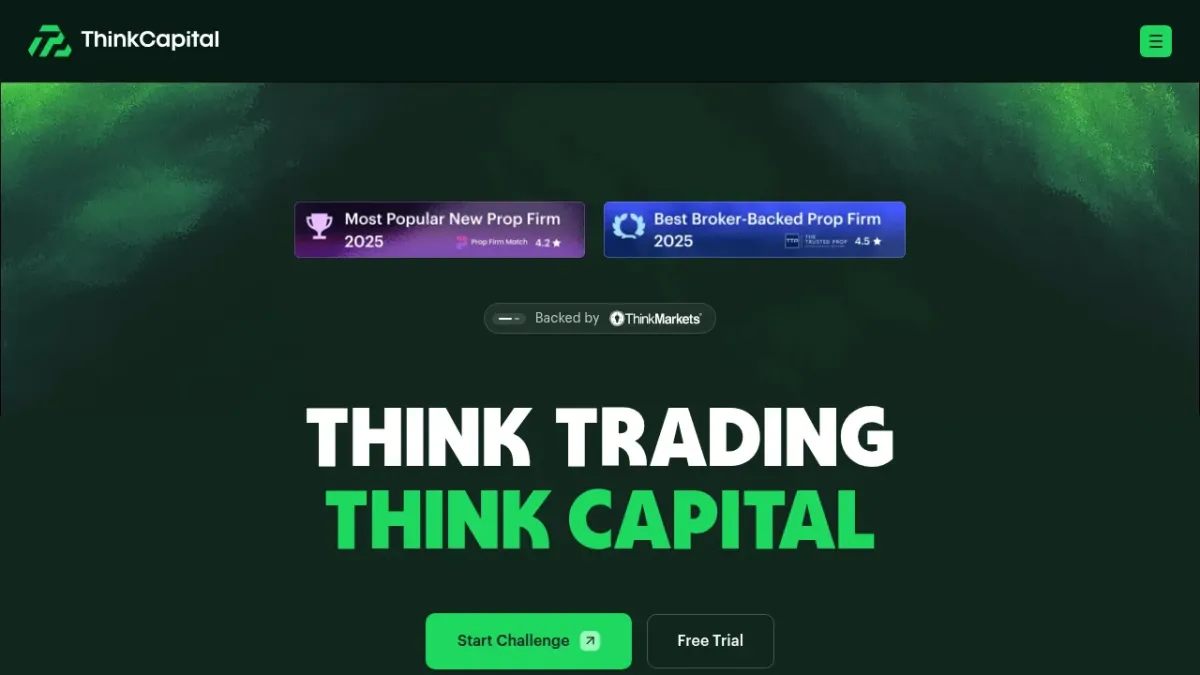
ThinkCapital is a proprietary trading firm that says it is backed by the broker ThinkMarkets. It sells three evaluations, Lightning (one step), Dual Step (two steps, in Intraday and Swing versions) and Nexus (three steps), and two accounts without an evaluation, Bolt and Bolt Flex. The terms say trading through the services is not real. The help centre names one platform, the ThinkMarkets app, which connects to TradingView, while the home page speaks of "a variety" of platforms.
The help centre has articles for each programme, but the help centre, the programme pages and the terms disagree on several points, among them Bolt's scaling and leverage, Expert Advisors, fee refunds and whether a funded account is live.
Who can use it
You must be over 18. The terms list restricted countries and regions, among them Australia, Cyprus, Russia, Iran, Vietnam and British Columbia. They let traders in Malaysia, Pakistan, Cambodia and Indonesia buy only Bolt and Bolt Flex, and anyone who uses a VPN to buy an account not offered in their country loses funded status and payouts.
The how-it-works page says the firm is open to US traders, and the terms let them use only the ThinkMarkets app. The terms allow one customer profile per verified person, which can hold several accounts, and require know-your-customer (KYC) checks before a Bolt or Bolt Flex account and before a funded account.
Safety and trust
The terms name TFG (Payments) Limited, with its registered office at Great Portland Street in London, as the provider, under the law of England and Wales. They say the company is not authorised or regulated anywhere, that your contract for the services is with it alone and that no other ThinkMarkets company is a party to it or guarantees it, and that ThinkMarkets' regulatory permissions, client-money protections and investor compensation arrangements do not extend to you. The help centre says ThinkCapital is led by Faizan Anees and backed by ThinkMarkets, which it describes as holding licences from authorities including the FCA, ASIC, CySEC and the FSCA.
The terms say the funds for demo trading are fictitious and call Bolt and Bolt Flex "simulated live trading" accounts, while the Bolt page speaks of trading "a live funded account". After an evaluation, the terms say you may be offered a funded-account contract by a third-party company that they do not name. The terms also let the provider end the contract without cause or notice and decide at its own discretion which trades are forbidden; they exclude its liability except for gross negligence, bad faith or intent to defraud, and cap it at the fee paid where a court finds it liable.
Trading conditions
The help centre says all accounts trade on one platform, the ThinkMarkets app, from which you can also trade through TradingView, while the home page speaks of "a variety" of platforms. The help centre lists forex, metals and other commodities, indices and crypto, with no crypto on Bolt and Bolt Flex. It says trading is commission-free with standard spreads that can be checked in the ThinkMarkets app before you buy, and that swaps follow ThinkMarkets' published rates. Its Dual Step drawdown article, however, counts commissions and swaps against the loss limit, and the risk disclosure says commissions and other fees may be shown on an account to simulate real costs without being charged to you. The site's disclaimer says the data feed is powered by liquidity providers.
The help centre gives Lightning a fixed 1:30 on forex, and Dual Step and Nexus tiers that fall as your open position grows: on GBPUSD, 1:100 up to 5 lots, down to 1:10 above 20 lots. For Bolt and Bolt Flex, it gives up to 1:100 on the smallest forex positions, while the Bolt page and the home page say up to 1:50. The terms let the firm change margin requirements at any time in line with changes in volatility or liquidity.
Rules
Lightning has a 3% daily loss limit on balance and a 6% maximum loss that trails until the account is 6% up and then locks at the starting balance. Dual Step has a 4% daily limit, on equity for Intraday and on balance for Swing, and a maximum loss fixed at 7% of the starting balance in the evaluation and 8% when funded. Nexus has a 4% daily limit and an 8% maximum loss on the starting balance. Bolt's 3% daily limit and 6% maximum loss follow equity, and Bolt Flex's 3% and 7% follow balance; both maximum losses lock at the starting balance.
The help centre bans trading from 2 minutes before to 2 minutes after high-impact news on Lightning, Dual Step Intraday and Nexus, and from 5 minutes before to 5 minutes after on Bolt and Bolt Flex, though positions opened before the window may be held through it. It says a breach ends the account and forfeits its profit, while the terms say that breaking their list of forbidden practices, news trading among them, ends all of the trader's accounts. Dual Step Swing allows news trading, and Lightning and Nexus offer a news add-on. Weekend holding is not allowed on Dual Step Intraday, and on Bolt and Bolt Flex it needs an add-on, without which positions must be closed by 21:00 UTC on Friday.
The Lightning and Dual Step pages list Expert Advisors as allowed, but the terms allow them only with the risk team's written permission, asked for by email, and only tools compatible with TradingView or the ThinkMarkets app. The terms ban copy trading and following other users' signals, forbid positions substantially larger than your other trades, and let the firm cut leverage to 1:5 for a forbidden practice. The programme pages and the terms ask for at least one trade every 30 days.
Plans and cost
Lightning asks for 10% profit in one step, Dual Step for 9% and then 5%, and Nexus for 7%, 6% and 5%, each with at least 3 trading days. The Lightning and Dual Step pages show unlimited trading days and no consistency rule. Bolt and Bolt Flex start funded, with no evaluation and no minimum of profitable days, and you may hold one active Bolt or Bolt Flex account per account size. Depending on the programme, add-ons bought with the account raise the share to 90%, shorten the payout cycle, or allow news trading or weekend holding, and the terms' list of options also names an EA add-on for Nexus.
The help centre says the fee is refunded automatically with the third funded payout on every programme. The terms say the same for Bolt and Bolt Flex, but for the evaluations they reimburse the fee once the funded account is in profit. The help centre also offers a full refund within 14 days of purchase if the account has not been traded, while the terms give consumers 10 days to withdraw and end that right with the first trade. Both allow a flat administrative fee to be held back from each refund, except where the refund follows the firm's own material breach or where holding it back would conflict with your statutory rights. The terms let the firm change fees and parameters at any time, though not for services already bought.
Payouts
The Lightning, Dual Step and Bolt pages and the help centre give a standard share of 80%. It rises to 90% with an add-on or, as the help centre and the Lightning and Dual Step pages say, once the account reaches the scaling milestone. The help centre says payouts follow a 14-day cycle that starts with your first funded trade and, after each payout, with your next trade. The Weekly Payouts add-on shortens the cycle to 7 days on Lightning, Dual Step and Nexus, and On-Demand Payouts lets Bolt and Bolt Flex traders ask at any time once eligible.
Lightning, Dual Step and Nexus need at least 3 profitable days in the cycle. On Bolt, your best day may not exceed 20% of the cycle's profit (25% on Bolt Flex), and the first payout needs at least 6% profit (7% on Bolt Flex). All positions must be closed, the account is locked until the payout is paid or rejected, and on Lightning, Bolt and Bolt Flex a payout that takes the balance down to the locked loss floor breaches the account.
The help centre names three payout methods: USDT, Rise, which deducts a flat fee once a month, and a transfer to a personal ThinkMarkets live account where ThinkMarkets accepts you; that route is closed to residents of the United States, Canada and Japan, among others. The terms speak instead of wire transfer or any other payment method available. The help centre says processing takes up to three business days.
Scaling
The help centre says Lightning, Dual Step and Nexus accounts grow by 20% of the starting balance after at least 10% profit and three withdrawals in a three-month review, and that the share then rises to 90%; the Lightning and Dual Step pages name only a 10% return in three months. Scaling is not automatic: you ask for it by email. The help centre gives a base maximum allocation that repeated scaling can raise.
For Bolt, the help centre and the Bolt page give 25% of the starting balance after 10% profit across four payouts within two months, while the terms say 20% after at least four payouts in a three-month review. Bolt and Bolt Flex scale together up to a combined maximum.
Pros and cons
For
- A named company in London and a named leader.
- Dual Step's maximum loss is fixed to the starting balance, with no time limit.
- The help centre returns the fee with the third funded payout on every programme.
Against
- Pages and terms disagree on several rules, among them Bolt's scaling and leverage, Expert Advisors and fee refunds.
- The help centre names one platform only, the ThinkMarkets app.
- The terms say the firm is not regulated and that ThinkMarkets' protections do not apply.
Who it suits
ThinkCapital suits forex traders who want a named company behind the account, a two-step evaluation with no time limit and a fixed maximum loss, or a funded account without an evaluation.
It does not suit traders who want a platform other than the ThinkMarkets app, news traders on Bolt and Bolt Flex, or anyone who wants to run a bot without asking the risk team first.
Verdict
Our BT Score for ThinkCapital is fair. A named company, a fixed maximum loss on Dual Step, Lightning and Dual Step evaluations with no time limit and the fee refund that the help centre ties to the third payout count in its favour. Against that stand the single platform the help centre names, an unregulated provider whose terms let it end the contract without cause, and pages that disagree with each other and with the terms on Bolt's scaling and leverage, Expert Advisors, fee refunds and other points.
FAQ
Is a ThinkCapital funded account a live account?
The pages disagree. The terms say no trading through the services is real and the risk disclosure says trades on a funded account are simulated, while the Bolt page speaks of trading "a live funded account".
Can I use an Expert Advisor at ThinkCapital?
The Lightning and Dual Step pages say yes, but the terms require the risk team's written permission, asked for by email, and allow only tools compatible with TradingView or the ThinkMarkets app.
Is ThinkCapital regulated?
No. The terms and the help centre say ThinkCapital itself is not regulated, and the help centre says the regulatory status of ThinkMarkets, the broker behind it, does not extend to ThinkCapital customers.
Sources
- www.thinkcapital.com/tc-faqs/funded-accounts/how-often-are-payouts-offered-for-simulated-funded-accounts/
- www.thinkcapital.com/terms-of-services/
- www.thinkcapital.com/tc-faqs/general-faqs/can-i-receive-a-refund-for-the-challenge-fees-or-after-successfully-completing-the-challenge/
- www.thinkcapital.com/tc-faqs/dual-step-program/how-is-the-maximum-simulated-drawdown-calculated-in-the-dual-step-intraday-challenge-funded/
- www.thinkcapital.com/
- www.thinkcapital.com/tc-faqs/general-faqs/what-trading-platforms-does-thinkcapital-offer-and-what-instruments-can-i-trade-there/
- www.thinkcapital.com/dual-step/
- www.thinkcapital.com/tc-faqs/funded-accounts/how-the-scaling-plan-works-on-simulated-funded-accounts/
- www.thinkcapital.com/about-us/