

The Trading Pit Review
The Trading Pit review covering CFDs, futures, payouts, rules, support sentiment, safety signals, and who should consider this multi-asset prop firm.
Review text updated September 13, 2026
Review method: published documents. The text update does not reverify every programme rule.
View tracked accounts and dated terms. Comparison coverage includes only the providers and plans currently collected.
Who is The Trading Pit
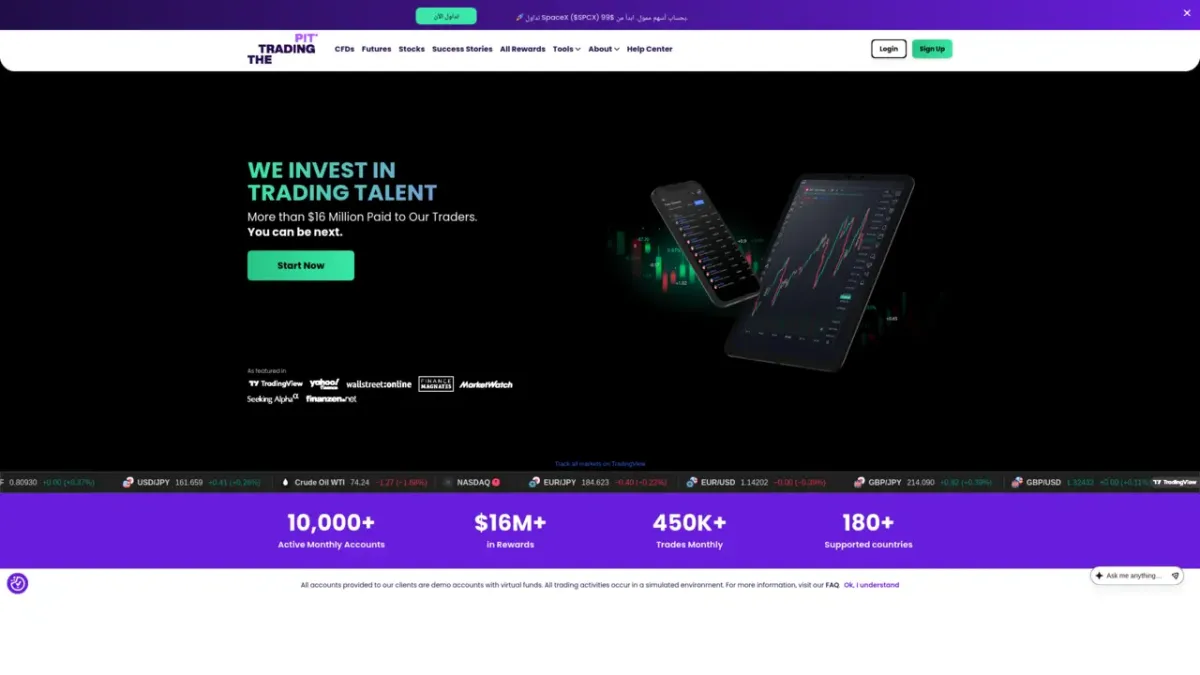
The Trading Pit is a multi-asset proprietary trading challenge provider built around virtual trading accounts. Its public site presents CFD, futures, and stocks challenges, with traders progressing from a challenge into what the firm calls an Earning Account after passing the required objectives and signing the relevant agreement.
The firm is clearer than many competitors about the simulated nature of the model. Its support center says The Trading Pit Challenge GmbH offers multi-asset virtual trading challenges in a demo or virtual environment and says it does not provide regulated financial services. That matters: traders are buying access to an evaluation and a contractual payout model, rather than opening a brokerage account with protected client money.
The account model depends on product line. CFDs are offered in Prime challenge structures with one-phase and two-phase options. Futures Prime is presented as a challenge with set balances, daily pause limits, maximum drawdown, contract limits, and an Earning Phase after passing. Stocks are promoted as a separate challenge line through the firm’s site and information pages.
At a glance
The Trading Pit is a legitimate, visible, multi-asset prop challenge brand with a deeper help center than the average new firm. Its strongest point is breadth: traders can compare CFDs, futures, and stocks under one brand, with product pages and support articles that spell out many of the constraints.
The trade-off is complexity. Payout rules, drawdown models, consistency requirements, inactivity rules, and product-specific restrictions all matter. Some conditions also depend on when an account was created, which means traders should treat the current rule page and their account dashboard as the controlling source.
The Trading Pit suits traders who want documented rules and multi-asset choice. It is a weaker fit for traders who want the simplest possible payout path or who tend to trade near drawdown limits.

Eligibility and who can use it
The firm states that it supports traders across many countries and says on its homepage that it has users in more than 180 supported countries. Its help center also says underage clients are handled through the firm’s eligibility rules, and account verification is part of the process before payouts or ongoing participation.
The practical eligibility test is simple: confirm your country, age, identity documentation, tax status, and payment method before buying a challenge. The firm’s support center has dedicated pages for KYC, proof of residence, payment methods, and account verification, so traders should use those before committing.
Because this is a virtual challenge model, eligibility also depends on accepting the firm’s account agreement, trading rules, and payout conditions. Traders using VPNs, shared devices, multiple locations, or automated systems should review the device, IP, network, and product-specific articles first.
Firm safety and trust
The Trading Pit is more transparent than many small prop brands about the legal perimeter of its business. Its support center says it offers virtual challenges in a demo or virtual environment and does not provide financial services. That is a useful disclosure, because it prevents traders from confusing the product with a regulated brokerage account.
The safety concern is also embedded in that disclosure. The firm is asking traders to rely on its commercial model, rule enforcement, and payout practice rather than on broker regulation or investor compensation schemes. There is no public evidence in the sources checked that customer challenge fees are segregated like brokerage client funds, and the firm does not present itself as a regulated financial-services provider.
On the positive side, the company publishes management, contact, support, and product-rule pages, and it has been operating as a visible brand across multiple regions. On the cautious side, prop firms remain counterparty-risk businesses. The strongest protection for traders is to size challenge spend modestly, read the rules, and withdraw promptly once eligible.
Trading conditions and execution
The Trading Pit publishes more execution detail than many review-only prop sites. The CFD page includes an instrument list with spreads, swap timing, and commissions by symbol. The futures page lists contract limits by account size and separates standard contracts from micros. That helps traders estimate whether their strategy can operate inside the account limits before buying.
Execution quality is still difficult to verify independently from the public website alone. Published spreads and commissions are useful, yet they do not prove fill quality, slippage behavior, platform stability, or how edge cases are handled during volatile sessions. Traders using news strategies, fast scalping, overnight exposure, or automation should verify whether their approach is allowed and whether the platform setup supports it.
The firm’s product menu is broad, which is useful for traders who know their market. It also creates more chances for misunderstanding. A CFD trader, a futures trader, and a stocks trader are operating under different product assumptions, so the correct rule page matters more than general brand reputation.
Rules and restrictions
The Trading Pit’s rules are detailed and product-specific. The most important restrictions are drawdown, daily limits or pauses, consistency requirements, inactivity, contract or lot limits, and payout qualification. The support center says that if equity falls to or below the maximum drawdown limit, the account is breached and permanently closed.
The inactivity rule is explicit. The help center says the rule applies to challenges and Earning Accounts, and an account can be breached after a set period with no executed trade. Holding an overnight position or leaving an unfilled pending order does not count as activity.
Drawdown models vary by program. The CFD Prime example on the public page uses daily drawdown and static maximum drawdown. Futures Prime uses a daily pause and a maximum drawdown, with an Earning Phase that scales buying power according to end-of-day profit. Older or discontinued products may have different mechanics.
The practical rule is this: read the product page, then read the matching support articles, then check the dashboard terms tied to your specific account. The Trading Pit is usable for disciplined traders, but it is unforgiving for traders who learn the rules after breaching them.
Plans and cost
The Trading Pit uses a challenge-fee model rather than a simple brokerage account model. Futures Prime plans on the checked page were presented as one-time challenge fees with separate reset and extension costs. CFD pricing is shown through a build-your-challenge interface that changes with balance and evaluation type.
Because prop-firm prices, activation terms, and product availability change frequently, this review avoids quoting a static price table. The comparison tool shows dated evidence for covered accounts. Confirm the exact plan, availability and checkout terms with the provider.
The cost shape is fairly standard for the sector: larger balances cost more, rules differ by product, and optional reset or extension fees can add to total spend. The apparent value depends less on headline account size and more on whether your strategy can pass the target without sitting near the breach level.
Payouts and how they get denied
Payouts are the key issue with The Trading Pit, as with every challenge-based prop firm. The public CFD Rewards Policy says traders earn 80% of profits generated during the Earning Phase and can request payouts every 14 days once requirements are met, with a minimum payout threshold. The futures page says traders keep 80% of generated profits, and it sets conditions for the first and later payouts.
The details matter. Futures payouts require profitable trading days meeting a minimum-profit condition, and the first withdrawal is capped by the lower of a fixed amount or a share of realized profit. Later payouts still require profit since the last payout request and the required profitable days. CFD payout rules also vary by account type and account creation date, including trading-day and consistency conditions for some accounts.
Common denial paths are therefore predictable. A trader can be profitable and still be ineligible if they miss the profitable-day requirement, breach the consistency rule, request too early, fall below the allowed drawdown, violate product restrictions, fail KYC, or trade in a way the firm treats as abusive. The firm’s own pages show that rules can differ by account creation date, which makes screenshots and saved terms useful.
Our view is charitable but cautious. The Trading Pit documents more payout logic than many firms, which is good. It also uses enough conditions that traders should model payout eligibility before placing the first trade.
Scaling and longevity
The Trading Pit’s Prime Earning Phase includes a scaling mechanism. The CFD page says the firm can increase account balance by 25% when the account has been active for at least two months, has received at least two payouts, and has accumulated at least 10% total profit on the initial balance. The futures page says buying power in Futures Prime is scaled based on end-of-day profit and adjusted daily.
That gives the firm a credible longevity story for consistent traders. It rewards traders who can survive beyond the first payout rather than simply pass a challenge once. The better question is whether the trader’s style is stable enough to benefit from scaling. High-variance strategies may reach a payout quickly, then lose the account before the scaling pathway becomes relevant.
Scaling should be treated as upside, rather than the reason to buy. The base account must work on its own terms.
Pros and cons
Pros:
- Multi-asset product range across CFDs, futures, and stocks.
- Public help center with detailed rule articles.
- Clearly disclosed virtual challenge model.
- Published payout policies for CFD and futures products.
- Scaling pathway for consistent traders.
Cons:
- CFD and futures programmes have different drawdown, position and payout conditions; older products may use different rules again.
- An open position or unfilled order does not satisfy the stated inactivity requirement. A drawdown breach can permanently close the account.
Who it suits
The Trading Pit is for traders who want a multi-asset prop firm, read rulebooks carefully, and can trade within defined drawdown and payout constraints. It is especially relevant for traders comparing CFD and futures challenge structures under one brand.
It is also for traders who value visible documentation. The support center is useful, and the product pages give enough detail to reject a plan before buying if the limits do not fit your strategy.
It is a poor fit for traders who rely on large intraday swings, hold positions without monitoring drawdown, need immediate payout flexibility, or dislike product-specific rule differences. It is also unsuitable for anyone who expects a regulated brokerage relationship, because the firm describes its offering as a virtual challenge model.
Our verdict
The Trading Pit is a serious multi-asset prop challenge brand with better-than-average documentation and a broad product lineup. The firm does many things right: it discloses the virtual nature of the model, publishes rule articles, lays out payout policies, and gives traders more product choice than a narrow futures-only shop.
The caution is that breadth comes with rule density. Payouts depend on more than being profitable, drawdown can close the account permanently, and account creation date can affect which rules apply. That makes The Trading Pit a reasonable choice for disciplined traders who want the specific products it offers, and a risky choice for anyone who buys first and reads later.
The comparison tool shows dated evidence for covered accounts. Confirm the exact plan, availability and checkout terms with the provider. If the payout path still makes sense after that, The Trading Pit belongs on the shortlist.
FAQ
Q: Is The Trading Pit a regulated broker?
A: No. The firm’s support center says it offers virtual trading challenges in a demo or virtual environment and says it does not provide financial services. Treat it as a prop challenge provider, rather than a regulated brokerage account.
Q: Does The Trading Pit offer live accounts?
A: The public materials describe challenges and Earning Accounts within a virtual or demo-style framework. Traders may be paid a share of profits under the firm’s agreement, but the challenge itself should be understood as a simulated evaluation model.
Q: What profit split does The Trading Pit advertise?
A: The checked CFD and futures pages state that traders keep 80% of generated profits during the earning stage, subject to the payout rules and eligibility conditions.
Q: What is the biggest payout risk?
A: The biggest risk is assuming that profitability alone is enough. Payout eligibility can depend on profitable trading days, minimum-profit thresholds, consistency rules, drawdown status, timing, KYC, and the rules tied to the account creation date.
Q: Are the rules the same for CFDs and futures?
A: No. CFDs, futures, and stocks have separate product structures and support articles. Read the rule page for the specific challenge you plan to trade.
Q: Should beginners use The Trading Pit?
A: Beginners should be careful. The documentation is helpful, but the rules are still strict. A beginner who cannot explain the drawdown, payout, and inactivity rules for the chosen plan should study first and buy later.
Provider documentation
The Trading Pit official website contains the provider's product pages and legal terms. Match the account, plan and country before applying a rule or advertised price.
Compare tracked prop firm accounts for account fees, rules and payout terms. Not every reviewed firm has accounts in the comparison.