

Lark Funding Review
Lark Funding review covering payouts, simulated accounts, rules, drawdown, trader sentiment, safety, pricing shape, and who should use it.
Review text updated September 13, 2026

Review method: published documents. The text update does not reverify every programme rule.
View tracked accounts and dated terms. Comparison coverage includes only the providers and plans currently collected.
Who is Lark Funding
Lark's platform and market guidance describes CFD trading and explicitly excludes futures and spot stocks. Forex, index and crypto symbols in this review are simulated CFD exposures, not exchange-traded futures.
Lark Funding is an online demo trading evaluation firm that says it has operated since 2022. Its current public positioning is built around career-style simulated trading rather than access to client-managed live capital.
The firm offers several account routes: instant access, a 1-step evaluation, and a 3-step evaluation. Its help center is explicit that all stages of the relationship are conducted on demo accounts. Passing an evaluation can lead to a Master Account, but Lark says no live funds are ever provided directly to the client. The company says trading data may be sent to a partnered proprietary trading firm, where trades can be copied at that firm's discretion.
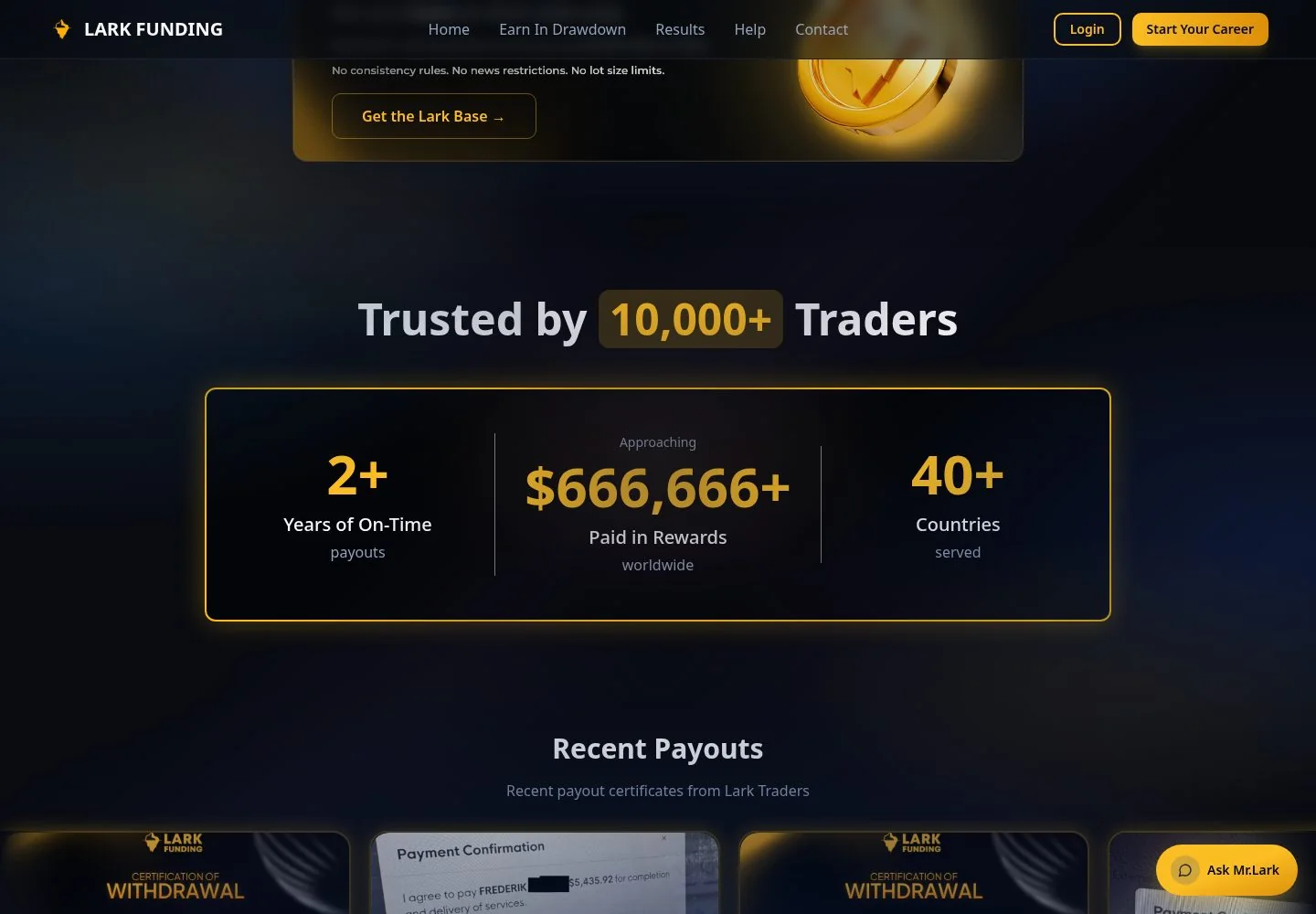
This makes Lark a simulated-performance payout program. The trader pays for access to a rules-based evaluation or simulated account, trades quoted markets in a demo environment, and may receive real rewards based on qualifying simulated gains.
At a glance
The caution is that the risk model is still discretionary at the edges. Lark's prohibited-strategy language covers all-or-nothing trading, high-frequency trading, group hedging, copy-trading abuse, and several forms of strategy mismatch. The firm also operates entirely in simulation and says it is outside securities registration because it does not provide live capital, investment advice, or access to client funds.
Our read: Lark is a plausible option for disciplined CFD prop traders who can live inside written rules, keep risk modest, and document their process. It is a weaker fit for traders who rely on maximum leverage, news spikes, social-copy systems, or ambiguous payout eligibility.
Eligibility and who can use it
Lark's terms say users must be at least eighteen and capable of entering the agreement. Its country-availability page excludes Iran, North Korea, Myanmar, the Russian Federation, Belarus, and Quebec. The firm also tells users to check whether Riseworks, its stated payout processor, is available in their country or region.
That last point matters. Passing an evaluation is only useful if the payout rail works where the trader lives. Traders should confirm both Lark eligibility and Riseworks availability before buying an account.
Firm safety and trust
The important limitation is regulatory. Lark says it is not required to register with a securities regulator or financial authority in Canada because its services do not involve live capital, investment advice, or custody of client funds. That explanation is common in the demo-prop sector, but it also means traders should view the relationship as a commercial services contract rather than a regulated brokerage or asset-management relationship.
The firm is safer than anonymous pop-up prop sites that hide their rules and legal entity. It is still a simulated payout business whose commercial model depends on fees, rule enforcement, and discretionary review.
Trading conditions and execution
Lark says all accounts are demo accounts, but that its demo environment uses third-party liquidity providers and simulated live trading conditions. It says these liquidity providers draw pricing from banks, prime brokers, market makers, and other liquidity sources, while also acknowledging it does not control or see the underlying providers at every point in time.
The tradable universe is broad for a CFD-style program. Lark lists demo access across forex, indices, crypto, metals, commodities, and U.S. stock CFDs. Leverage differs by product and program. Commissions are stated for FX and metals, with separate stock share-based commissions, while crypto, indices, and oil are described as commission-free in the relevant help articles.
The execution claim is credible enough for a simulated prop product, but traders should remember the practical point: this is not a direct brokerage account. Slippage, spreads, commissions, data-feed behavior, and payout review all sit inside Lark's commercial simulation environment.
Rules and restrictions
Lark's rulebook is easier in some headline areas and stricter in behavioral review. News trading is allowed according to the help center, provided the trader remains risk-managed. Scalping and ordinary active trading are less of a headline problem than with some firms.
The real restriction is prohibited strategy review. Lark bans all-or-nothing trading, gambling-style behavior, HFT, group hedging, signal-service use, account-passing services, and trades that mirror other traders or groups across accounts. It also bans holding single-share equity CFD positions through earnings, dividends, or other corporate actions.
Drawdown depends on the program. The 1-step evaluation uses a static max drawdown model. The 3-step evaluation uses a static maximum loss limit and no daily loss limit. Instant accounts use a daily loss limit and a trailing maximum loss limit that can lock at the initial balance after sufficient gain or after the first payout request.
The practical lesson is simple: Lark rewards controlled, repeatable trading. It is a poor venue for one-shot passes, oversized trades, latency tactics, or anything that looks coordinated across accounts.
Plans and cost
Lark's cost structure varies by account route, account size, add-ons, and seasonal site configuration. The public site shows instant, 1-step, and 3-step options, with account sizes from smaller starter accounts through larger simulated capital accounts. It also advertises bundled features such as reset protection, journaling, coaching, and advisor-style support.
The comparison tool shows dated evidence for covered accounts. Confirm the exact plan, availability and checkout terms with the provider.
The cost shape is conventional for a CFD prop program, with higher account sizes and richer features costing more. Traders should also check payout fees and add-on costs, since those affect net economics after passing.
Payouts and how they get denied
Payouts are the strongest part of Lark's public pitch and the most important part of the risk analysis. Lark says payout requests are submitted through the trader dashboard. For evaluation-based accounts, the stated cadence is bi-weekly. For instant accounts, Lark says the first payout is available on demand, while later payouts follow a longer cycle. The firm says it uses Riseworks for withdrawals, applies a flat processing fee, and generally handles payouts quickly while reserving extra business days for processing.
The main denial risk comes from rules rather than payment rails. Lark's prohibited-strategy article says all-or-nothing trading can lead to account closure and forfeiture at the company's discretion. Its gain-limit enforcement says funded-account trades exceeding the cap can be excluded, and repeated violations can result in an immediate breach with no payout. The terms also say certain prohibited trading can lead to payout removal.
For traders, this means the payout question is less about whether Lark has a button to withdraw and more about whether your trading record survives review. Keep position sizing conservative, avoid clustered one-idea trades that look like a single oversized bet, stay away from group or copied strategies, and close equity CFDs before corporate events.
Scaling and longevity
Lark markets itself as a career-style prop firm and advertises virtual capital up to large account sizes. It also presents monthly base-style rewards and performance rewards as part of the account experience. That is a distinctive positioning compared with firms that focus only on passing a challenge and withdrawing simulated gains.
Limitations
- Signal services, account-passing services, high-frequency trading and coordinated-account strategies are restricted, even where ordinary news trading is allowed.
- Instant accounts use trailing loss limits that can lock after sufficient gains or a payout request. Their withdrawal and risk planning differs from the static-loss evaluation routes.
Who it suits
Lark Funding is for disciplined CFD traders who already have a repeatable process, can trade inside a defined drawdown limit, and value quick stated payout processing. It is also a reasonable candidate for traders who want a simulated prop environment with broad market coverage and fewer headline news restrictions.
It is a poor fit for traders who need regulated brokerage custody, direct live capital, or guaranteed copying of their trades into a real fund. It is also unsuitable for traders who rely on signal rooms, account-passing services, group hedging, HFT, oversized news bets, or one-shot challenge tactics.
If your edge requires ambiguity, Lark is risky. If your edge is controlled execution and clean documentation, Lark is more plausible.
Our verdict
The verdict comes with a clear caveat. This is a demo-account rewards business, not a regulated capital allocation. The firm can review trading behavior, enforce broad prohibited-strategy rules, and deny or adjust payouts when it decides a trader crossed the line. That does not make Lark unusable. It means the right trader should approach it as a rules contract first and a funding brand second.
Our view: consider Lark if you trade conservatively, understand the payout rules, and can accept simulated-account economics. Skip it if you want regulatory protections, live-account certainty, or a high-risk challenge-flipping venue.
FAQ
Is Lark Funding a live funded account?
No. Lark says all stages are conducted on demo accounts and that no live funds are ever provided directly to the client.
Does Lark Funding allow news trading?
Yes, according to its help center, Lark says it currently has no restrictions around news events. Traders still need to avoid all-or-nothing behavior and keep risk managed.
How do Lark Funding payouts work?
Lark says payout requests are submitted through the dashboard and processed through Riseworks. Evaluation-based accounts have a recurring payout cadence, while instant accounts have a different first-payout structure.
Can Lark Funding deny a payout?
Yes. Lark's rules allow payout denial or account breach for prohibited strategies, repeated gain-limit violations, HFT, group hedging, account-passing services, and certain equity CFD corporate-action violations.
Is Lark Funding regulated?
Lark says it is not required to register with a securities regulator or financial authority in Canada because it does not provide live capital, investment advice, or custody of client funds.
Who should avoid Lark Funding?
Traders who use copied signals, group strategies, oversized single-trade risk, HFT, or corporate-action equity CFD holds should avoid it. So should anyone who needs a regulated brokerage-style relationship.
Provider documentation
Lark Funding official website contains the provider's product pages and legal terms. Match the account, plan and country before applying a rule or advertised price.
Compare tracked prop firm accounts for account fees, rules and payout terms. Not every reviewed firm has accounts in the comparison.