

Goat Funded Trader Review
Goat Funded Trader review for 2026 covering payout claims, simulated funding rules, denial risk, support signals, account models and trader fit.
Review text updated September 13, 2026

Review method: published documents. The text update does not reverify every programme rule.
View tracked accounts and dated terms. Comparison coverage includes only the providers and plans currently collected.
Who is Goat Funded Trader
Goat Funded Trader, usually shortened to GFT, is a retail prop-style trading firm that sells access to simulated funded accounts. Its current public site presents the product as simulated capital with real rewards, meaning the trader is using a demo-style environment and may receive a cash reward if the account qualifies under GFT's rules.
The model range is wider than many firms. The public account selector shows instant, one-step, two-step, and three-step routes, plus separate model types under the GFT brand. The site also promotes MT5 availability and multiple platform choices, though the public marketing page gives more detail on account selection than on broker relationships or execution dispute handling.
At a glance
GFT is easy to understand at the headline level: choose a model, trade simulated capital, respect the drawdown and prohibited-practice rules, then request rewards. The attractive parts are the broad account menu, no time-limit messaging, a high advertised profit split, and an official payout-time commitment.
The caution is equally clear. The rulebook contains broad discretion, including language that allows the firm to breach and refund traders for styles it deems too risky. Public trader complaints found during this review focused on denied payouts or suspensions after profitable trading. Treat GFT as a rule-sensitive, discretionary simulated-funding product rather than a simple capital allocation program.
Eligibility and who can use it
GFT presents itself as a worldwide trader program and says a large global trader base uses the platform. The help center points users to account access, KYC, and support channels, and payout timing can be delayed where identity verification or extra data clarification is pending.
As with any prop-style account, eligibility is practical as much as geographic. You need to pass identity checks, use a permitted platform, trade instruments allowed under the chosen model, and avoid account-access patterns that trigger policy review. Traders using shared devices, multiple accounts, VPNs, or third-party automation should read the relevant help-center articles before buying anything.
Firm safety and trust
The safest way to frame GFT is as a simulated-account rewards business. The homepage says traders use simulated capital and are not liable for losses. That lowers personal downside compared with trading your own capital, but it also means the real commercial risk shifts to rule interpretation, reward approval, and whether the firm remains willing and able to pay qualified traders.
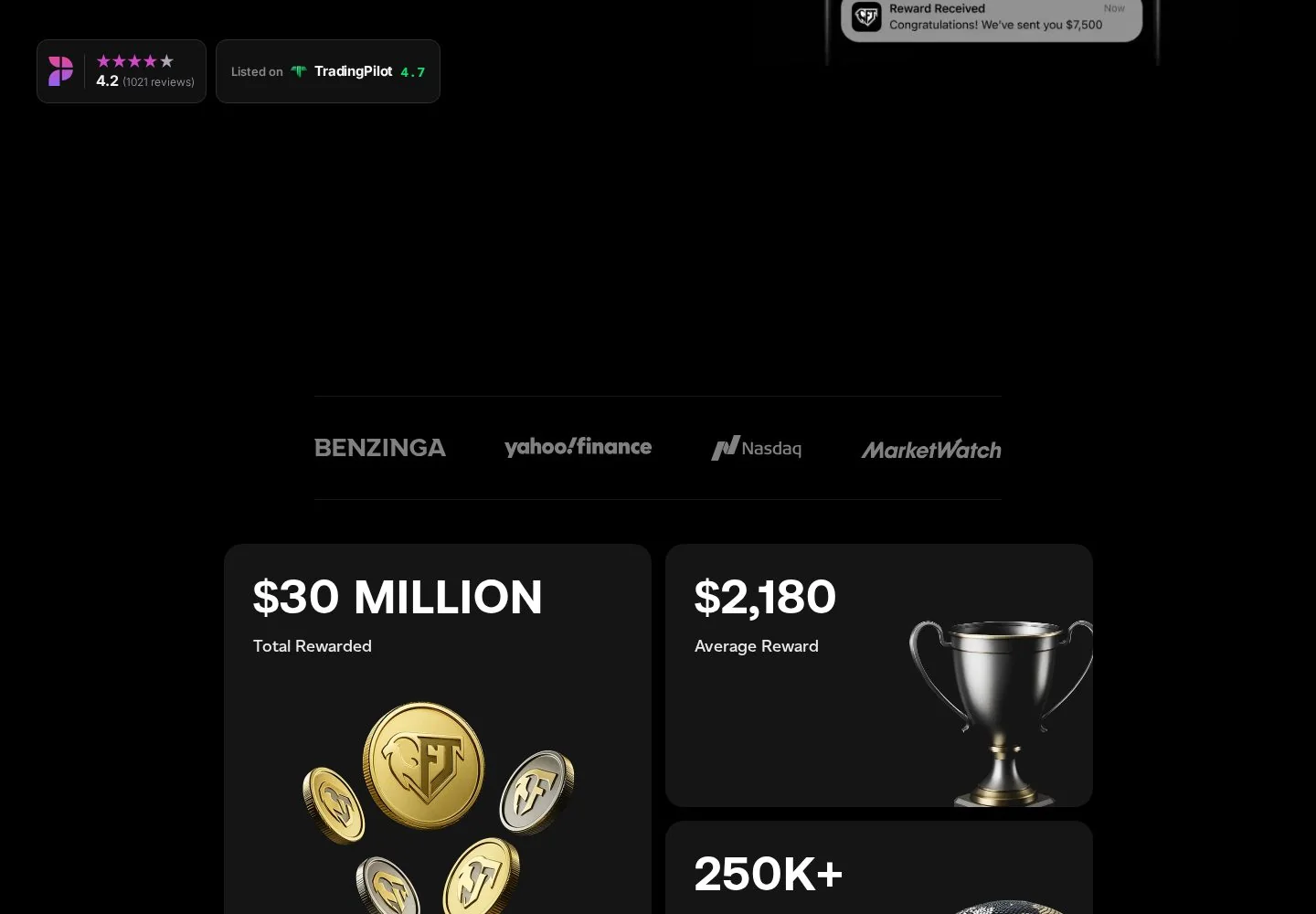
The public site makes strong payout and community claims, including large aggregate rewards paid and a large trader count. I could verify that these claims are displayed on the official site, but I did not find audited payout records, regulator oversight, clear external capital backing, or detailed ownership information in the pages reached during this pass. That does not prove weakness, but it leaves the safety case more dependent on the firm's own claims and trader feedback.
Trading conditions and execution
GFT advertises MT5 availability and presents several platform choices in the account selector. It also says traders can trade with their favorite platform and withdraw through channels including bank transfer, crypto, Skrill, and Rise.
The public materials reached during this review were lighter on execution detail. I did not find a clear, trader-facing explanation of broker routing, spread source, slippage review, trade-cancellation standards, or an independent process for execution disputes. That matters because the prohibited-practices policy includes language about latency, pricing errors, broker relationships, and trades that may be cancelled. Active intraday traders should assume execution and strategy-review questions are important before purchase.
Rules and restrictions
The rulebook is the main risk area. GFT prohibits exploiting pricing or platform errors, using non-public information, front-running, trading in a way that jeopardizes broker relationships, all-or-nothing trading, hedging, martingale, third-party strategies or EAs marketed to pass assessments, copy trading between accounts, and switching between EA and manual approaches across stages where the firm determines that the strategy changed.
The broadest phrase is the most important one: any trading style the firm deems too risky can be breached and refunded in full. The policy also says prohibited trading can lead to termination, closure of a simulated funded account, and forfeiture of profits. That discretion gives GFT room to police abuse, while also creating uncertainty for traders whose edge is aggressive, automated, highly concentrated, or difficult to explain.
For drawdown, the homepage account selector showed an instant-account example with a daily loss limit and a maximum loss limit. The comparison tool shows dated evidence for covered accounts. Confirm the exact plan, availability and checkout terms with the provider.
Plans and cost
GFT's plan menu is broad. The current site shows instant, one-step, two-step, and three-step paths, account sizes from smaller trial-style balances up to large simulated accounts, platform choices, and optional profit-split configuration.
The cost shape is a one-time fee that the firm describes as refundable under its rules. Exact fees and model availability change frequently, and the homepage also carries rotating promotional banners. The comparison tool shows dated evidence for covered accounts. Confirm the exact plan, availability and checkout terms with the provider.
Payouts and how they get denied
GFT's official payout promise is direct: once a reward request is submitted, the firm says traders can expect payment within two business days. It also advertises an added bonus if it misses that window, except where delay is caused by KYC problems or requests for extra data clarification.
The practical takeaway is simple: the payout promise is meaningful only if the account survives rule review. Keep records of strategy logic, device access, platform conditions, KYC, trade rationale, and any support conversation. If your strategy involves fast entries, large size, EAs, copying, recovery grids, hedging, or highly concentrated risk, clarify in writing before you trade for rewards.
Scaling and longevity
GFT advertises simulated capital up to $2M and says traders can scale from a large base allocation to that upper level. The homepage also promotes a high profit split and on-demand reward language.
The longevity question is less about the top number and more about consistency. A trader who uses modest risk, avoids edge-case platform behavior, keeps one clear strategy, and documents activity is better aligned with the rulebook than a trader trying to force maximum payout quickly. The scaling program looks attractive on paper, but the broad discretion in the rules means long-term users should prioritize boring, explainable trading over clever rule arbitrage.
Pros and cons
Pros:
- Multiple account paths, including instant and evaluation-style models.
- Official payout timing commitment.
- High advertised profit split availability.
- Broad help center with specific rule articles.
- One-time fee structure described as refundable under the firm's terms.
Cons:
- Simulated-account model depends on reward approval rather than live capital allocation.
- Broad discretion around risky trading styles.
- Public complaints found in this pass focused on payout denial and suspension.
- Execution and broker transparency were limited in the pages reviewed.
- Promo-heavy marketing can distract from the rule risk that actually decides outcomes.
Who it suits
GFT is best suited to traders who want a wide choice of account models, can follow a strict rulebook, trade one explainable strategy, and are comfortable operating inside a simulated rewards framework. It may also suit traders who value no time-limit messaging and a large advertised profit split more than institutional-style transparency.
It is a poor fit for traders who rely on hedging, martingale, third-party pass-service EAs, copy trading across accounts, very short latency-sensitive execution, or large all-or-nothing positions. It is also a poor fit for anyone unwilling to document their strategy and challenge history. With GFT, the trade is only one part of the job; surviving compliance review is the other.
Our verdict
Goat Funded Trader is a legitimate-looking, active simulated-funding brand with a large product menu, a polished site, and a published help center. The firm gives traders plenty of ways to enter, and its official payout language is stronger than vague marketing promises.
The weakness is trust under stress. The rulebook gives the firm wide room to decide that a strategy is too risky or prohibited, and the trader sentiment found in this pass included payout-denial allegations. That combination makes GFT a reasonable candidate for disciplined, low-drama traders who read rules closely, and a risky choice for aggressive traders who expect every profitable result to be paid without interpretation.
FAQ
Q: Is Goat Funded Trader a live funded account?
A: The public site describes the product as simulated capital with real rewards. Traders should treat it as a simulated-account rewards program rather than a traditional live capital allocation.
Q: How fast does GFT say it pays?
A: The help center says reward requests are expected within two business days, excluding weekends and public holidays. KYC issues or requests for extra data can delay processing.
Q: Can GFT deny a payout?
A: Yes. The rules say prohibited trading can lead to account closure and forfeiture of profits. The highest-risk areas include hedging, martingale, third-party pass-service EAs, copy trading between accounts, exploiting pricing errors, and trading styles the firm deems too risky.
Q: Are EAs allowed?
A: The rules are restrictive. GFT warns against third-party strategies, off-the-shelf systems, and EAs marketed to pass assessments, and says it may require proof that an EA is your own.
Q: Is news trading allowed?
A: The homepage promotes news trading as allowed, but traders should still read the current model-specific rules because allowed trading does not remove drawdown, execution, or prohibited-practice risk.
Q: Should I buy from the homepage price?
A: The comparison tool shows dated evidence for covered accounts. Confirm the exact plan, availability and checkout terms with the provider. Pricing and model terms can change, while review prose goes stale.
Provider documentation
Goat Funded Trader official website contains the provider's product pages and legal terms. Match the account, plan and country before applying a rule or advertised price.
Compare tracked prop firm accounts for account fees, rules and payout terms. Not every reviewed firm has accounts in the comparison.