

Elite Trader Funding Review
Elite Trader Funding offers varied futures evaluations and a path to live capital, with attractive splits balanced by dense rules and payout audit risk.
Review text updated September 13, 2026
Review method: published documents. The text update does not reverify every programme rule.
View tracked accounts and dated terms. Comparison coverage includes only the providers and plans currently collected.
Who is Elite Trader Funding
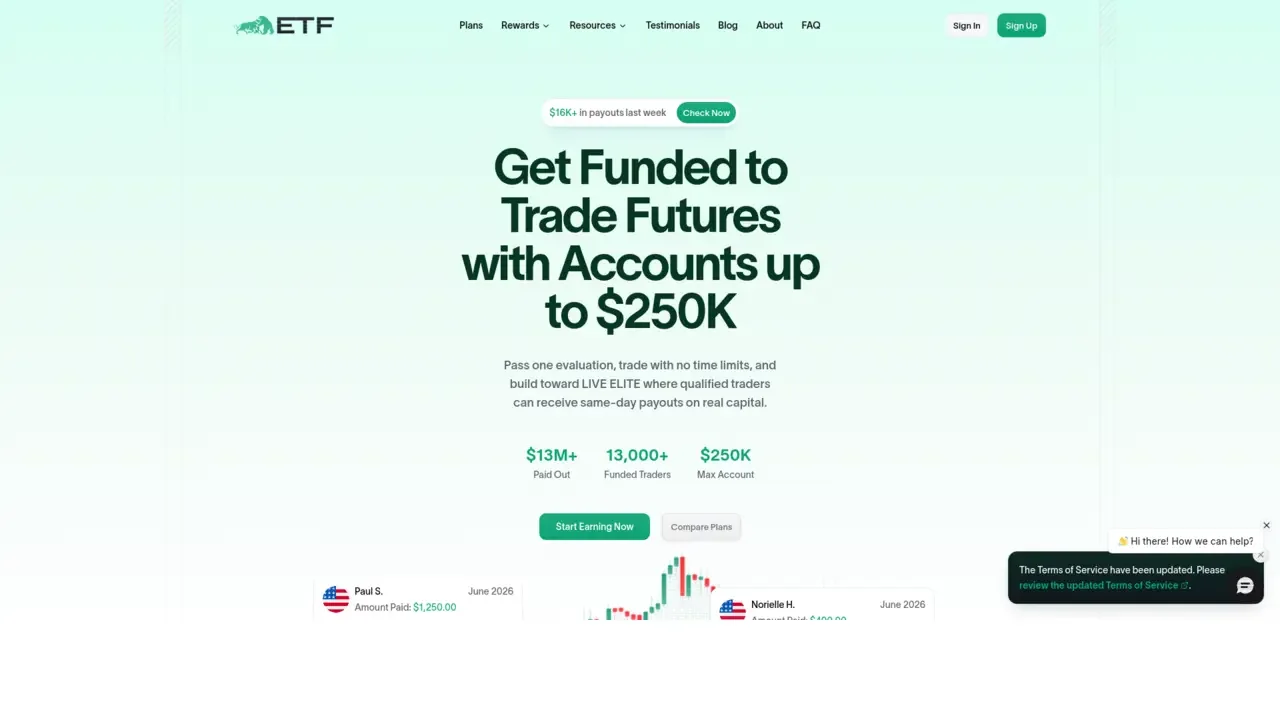
Elite Trader Funding is a US futures evaluation company founded in 2022 by Kanwal Singh. Its catalogue spans 1-Step, Direct to Funded, Static, Diamond Hands, End of Day and Fast Track plans. The lineup is primarily one-step or direct-to-funded; the current product page showed no conventional two-stage challenge. Evaluations run in simulated futures accounts with live market data. Traders who pass receive an Elite Sim-Funded account, while ETF reserves LIVE ELITE for selected traders using firm capital in a live broker account.
This distinction matters. Evaluation balances and Elite Sim-Funded balances are synthetic. The company pays cash rewards against qualifying simulated performance, then may transition consistently profitable traders to live capital. ETF says a trader can reach that transition after $25,000 in cumulative simulated payouts, although the current Terms also permit an earlier conversion.
At a glance
ETF gives futures traders unusually broad choice across drawdown styles and account structures. Its strongest attractions are multiple supported platforms, no completion deadline on the standard 1-Step evaluation, and simulated rewards advertised at up to the full qualifying amount.
The trade-off is a demanding payout framework. Active Trade Days, a safety net, weekly activity, payout audits, position controls, a loss-limit rule and ETF's discretionary interpretation all sit between dashboard profit and cash received. This review does not establish support responsiveness or payout reliability from independently verified account records.
Eligibility and who can use it
Applicants must be at least 18, or the age of majority where they live if that threshold is higher. ETF also restricts jurisdictions according to sanctions and the requirements of US futures commission merchants, clearing firms and brokers. The restricted-country list can change, so traders should verify the current official list before paying.
Payouts require identity verification and Rise onboarding. Personal details must match across ETF, the payment provider and compliance vendors. The Terms also exclude certain people with specified criminal, regulatory or financial histories and require enough English proficiency to use the service and understand the contract.
Firm safety and trust
ETF is operated by Elite Trader Funding LLC and publishes a Delaware mailing address, an identified founder and detailed Terms. It has operated since February 2022. The company says it has paid more than $13 million to more than 13,000 traders, although we found no independent audit supporting those marketing figures.
ETF is an evaluation company rather than a broker, futures commission merchant, commodity trading adviser or custodian. Most accounts hold synthetic currency, and the Terms say ETF owns all funds in every account. Traders therefore rely on the firm's finances and contract enforcement for simulated rewards, without broker-style customer-fund protections.
Counterparty visibility remains limited. Public materials do not disclose audited financial statements, payout reserves, beneficial ownership percentages or capital adequacy. The current Terms also require arbitration, waive class proceedings and allow revisions through website publication. Those features create elevated contractual risk even though we found no verified regulatory enforcement action during this review.
Trading conditions and execution
ETF supports TradingView, NinjaTrader, Tradovate, Rithmic and Tickblaze across its product ecosystem. Evaluations and Elite Sim-Funded accounts use simulated execution with live market data. LIVE ELITE uses the firm's money in a live broker account.
The available platform choice is useful, especially for futures traders who already know Tradovate or NinjaTrader. Still, simulation can differ from live fills, liquidity and slippage. ETF's CFTC disclosure explicitly warns that simulated results may understate or overstate market effects. We found no independent execution study measuring fill quality, outages or slippage across ETF's supported connections, so execution quality remains only partly verifiable.
Rules and restrictions
Drawdown depends on the plan. The 1-Step model trails the highest unrealized profit intraday until the trader builds realized profit equal to the maximum drawdown plus $100. The floor then becomes static at the starting balance plus $100. End of Day and Diamond Hands use end-of-day realized-profit logic, while Static holds one fixed minimum balance. Some families also impose a daily loss limit.
Funded rules extend well beyond drawdown. Traders must respect contract limits, avoid hedging across correlated instruments, close positions before the applicable market close unless a plan is exempt, use the current high-volume contract and place at least one trade each week. The Terms prohibit unauthorized automation, high-frequency abuse, arbitrage, wash trades, account sharing, trading for another person, loss-chasing Martingale and adding to a losing position through dollar-cost averaging. Elite accounts must also remain flat around listed major economic releases.
A later loss-limit rule can apply after substantial profit growth. ETF says a drawdown of more than 35% of accumulated profit from that point can remove the account from the simulated program and end live eligibility. Violations may lead to extra trading days, delayed or withheld payouts, forfeited profit, suspension or closure.
Plans and cost
The catalogue covers recurring evaluations, direct-to-funded access and several drawdown families. Account sizes and inclusions vary by model. Standard evaluations renew automatically on a fixed billing cycle until passed or cancelled, and traders may encounter separate reset, activation and market-data choices. ETF also offers one-time and recurring activation structures on some plans.
The evaluation catalogue distinguishes 1-Step, Fast Track, End of Day, Static Drawdown, Diamond Hands and Direct to Funded. Its largest displayed account differs from the homepage's headline range. Use the selected programme's current contract and checkout rather than a company-wide maximum. Intraday trailing, end-of-day trailing and static floors should not be treated as equivalent rules.
That creates a layered total cost: evaluation access, possible renewals, optional resets, funded activation and any platform or data extras. Exact figures change frequently. The comparison tool shows dated evidence for covered accounts. Confirm the exact plan, availability and checkout terms with the provider.
Payouts and how they get denied
This is the decisive part of the review. ETF advertises up to the full qualifying simulated reward and an 80% trader share in LIVE ELITE. Simulated withdrawals start at $250 and follow account-specific cycle caps. The standard path requires the safety net, the relevant number of Active Trade Days, an active subscription, KYC, Rise onboarding and a compliance audit. ETF promises approval of eligible requests within 48 hours, subject to weekends, holidays, outages, vendor delays and account standing.
An Active Trade Day requires a minimum realized profit and a result tied to the trader's best day. The best-day reference persists after a payout, which can make later qualifying days harder after one unusually large session. The safety net stays in the account and cannot be withdrawn. Trading must pause after a request until Payroll sends approval.
A payout can be delayed, withheld or denied after a rule breach, failed KYC, missed weekly trade, insufficient safety net, too few qualifying days, prohibited position management, a contract-limit breach, failure to flatten, restricted news trading or an audit finding of abnormal activity. The Terms also let ETF judge whether too much profit came from one day and interpret prohibited conduct at its sole discretion. Three denials for balance, activity or abnormal-behavior reasons can lead to account revocation.
LIVE ELITE conversion adds another layer. ETF can convert a trader before, during or after a payout request. Conversion closes all Elite Sim-Funded accounts, and the Terms say no further payout is owed from those accounts. ETF may allocate part of a pending request to the live account and decides the starting live capital. A trader who declines conversion faces sharply reduced settlement terms and a two-year exclusion. The practical distinction is between a displayed simulated balance, an approved cash entitlement and a live-account allocation.
The denial framework is broad. Traders should save the applicable plan page and Terms at purchase, keep their own trade logs, avoid borderline position management and request clarification in writing before using any strategy that could resemble hedging, automation, scaling into loss or payout-cycle gaming.
Scaling and longevity
ETF's main progression route is movement from Elite Sim-Funded status to LIVE ELITE. The live stage uses company capital, pays the trader an 80% share and can offer business-day payouts. Reaching the simulated payout cap can trigger consideration, while the Terms permit conversion earlier and cap the number of simulated payouts or Active Trade Days before consideration.
This is a genuine path toward live risk, which gives the model more substance than an endless simulated loop. The same framework gives ETF wide control over account size, contract limits, risk parameters, payout eligibility and continued participation. Previous performance does not guarantee a particular allocation or future scaling. Longevity therefore depends on both repeatable trading and the firm's ongoing capital decisions.
Pros and cons
Pros
- Six plan families with live trailing, end-of-day and static drawdown choices
- Simulated rewards advertised at up to the full qualifying amount
- Defined route to a company-funded live account
- Broad futures platform and data-feed support
- No maximum completion period on the standard 1-Step evaluation
Cons
- Dense funded-account and payout-audit rules
- Intraday unrealized trailing drawdown on the popular 1-Step plan
- Weekly activity, safety-net and Active Trade Day requirements
- Broad discretion over rule interpretation and live conversion
- Sim-funded accounts close when ETF moves a trader live
- Limited public evidence on reserves, audited payouts or ownership structure
Who it suits
ETF suits disciplined futures traders who can choose a drawdown model that matches their style, trade consistently across multiple days and maintain detailed records. It also fits traders who value platform choice and genuinely want a route into a live account.
Traders who scale into losing positions, trade major releases, use automated systems without written approval, take long breaks or depend on one outsized winning day face poor alignment. Anyone seeking a simple payout formula, guaranteed access to displayed simulated profit, broker-style protections or full control over the timing of a live transition should choose a different model.
Our verdict
Elite Trader Funding offers several futures programme structures and a documented route to a live-capital stage. The depth of its published rules makes programme selection and payout conditions central to the decision; documentation alone does not establish delivery quality or payout reliability.
The central weakness is the distance between simulated profit and cash entitlement. Qualification depends on layered activity rules, audits and discretionary judgments, while ETF can redirect a trader into LIVE ELITE and close the simulated accounts around payout time. That structure may work for careful, repeatable traders who accept ETF's live-first philosophy. It creates too much uncertainty for traders who view every displayed simulated dollar as withdrawable earnings. Read the current plan article and Terms together before paying, then trade well inside the boundaries.
FAQ
Is Elite Trader Funding a broker?
No. ETF describes itself as a performance-paid evaluation service. Most accounts are simulated; LIVE ELITE uses firm capital in a live broker account.
Are ETF accounts simulated or live?
Evaluations and Elite Sim-Funded accounts use synthetic balances with live market data. ETF may later move selected traders to LIVE ELITE.
How does the 1-Step drawdown work?
It trails the highest unrealized profit intraday until realized profit reaches the maximum drawdown plus $100. The floor then locks at the starting balance plus $100.
What must happen before the first payout?
The trader must build the safety net, complete the applicable Active Trade Days, keep the subscription active, pass the account audit, complete KYC and onboard with Rise.
Can ETF deny or delay a payout?
Yes. The published grounds include failed verification, unmet activity or balance requirements, rule violations and audit findings. ETF may also require additional trading days.
What happens when ETF moves a trader to LIVE ELITE?
The simulated funded accounts close, ETF assigns the live capital and contract limits, and some pending simulated rewards may be allocated to the live account under the Terms.
Provider documentation
Elite Trader Funding official website contains the provider's product pages and legal terms. Match the account, plan and country before applying a rule or advertised price.
Compare tracked prop firm accounts for account fees, rules and payout terms. Not every reviewed firm has accounts in the comparison.