

Crypto Fund Trader Review
Crypto Fund Trader review covering simulated accounts, platform access, drawdown rules and payout eligibility. Check the terms before paying for a challenge.
Review text updated September 13, 2026
Review method: published documents. The text update does not reverify every programme rule.
View tracked accounts and dated terms. Comparison coverage includes only the providers and plans currently collected.
Who is Crypto Fund Trader
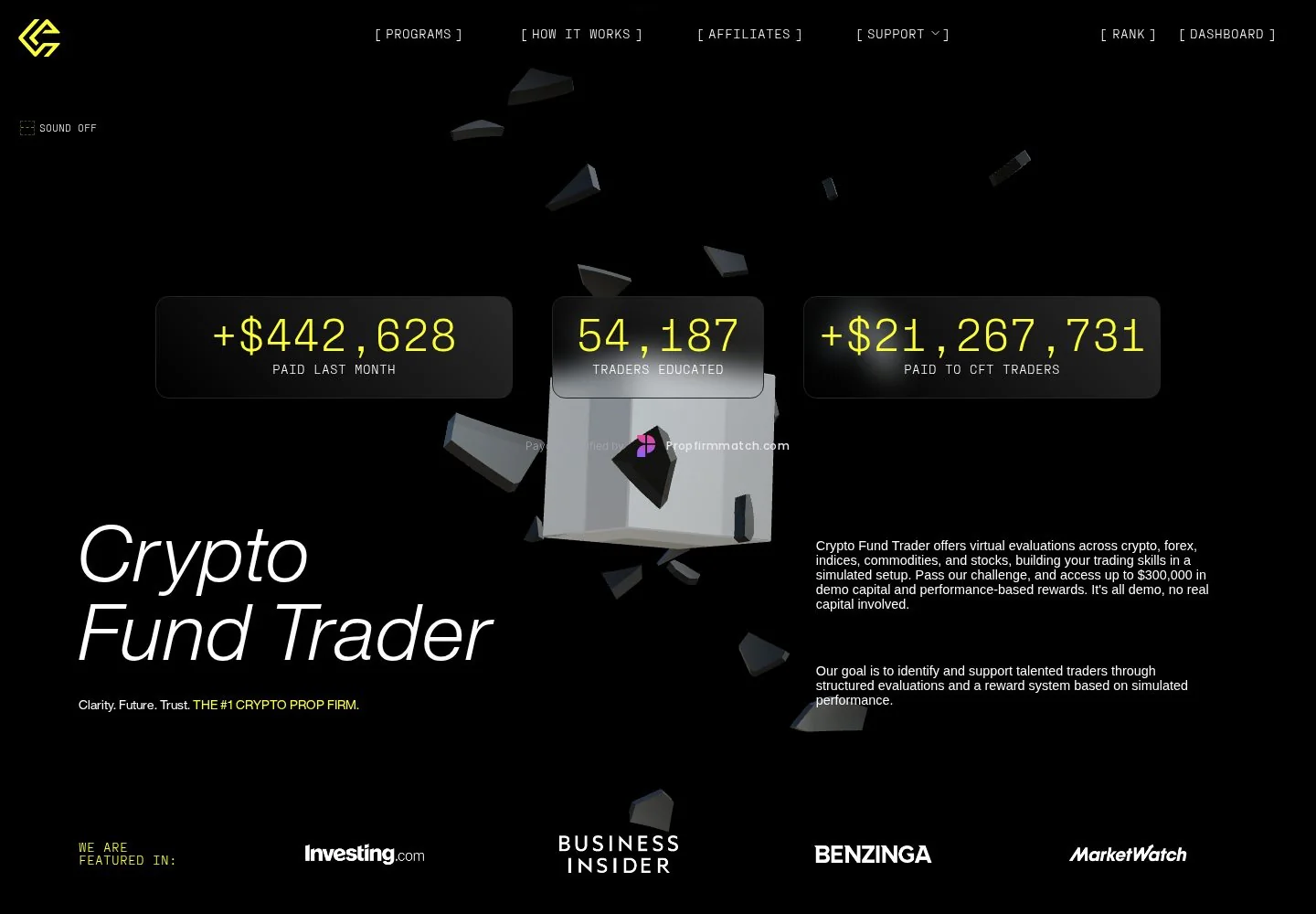
Crypto Fund Trader is a simulated trading evaluation firm focused on crypto, with additional markets including forex, indices, commodities, and stocks. The firm says traders complete a structured evaluation, then may qualify for a simulated funded account with virtual capital and performance-based rewards.
The current model includes instant, single-phase, and two-phase style paths, depending on the program selected. The firm states clearly that the capital is demo capital, and that rewards are based on simulated performance rather than a live allocation of the trader’s own funds.
The official FAQ lists MT5, MatchTrader and Bybit. Country access depends partly on platform choice, with MT5 unavailable for United States residents and Bybit use subject to Bybit’s own jurisdiction rules.
At a glance
Crypto Fund Trader is interesting for crypto-first traders who want a broad simulated market list, flexible timing, and visible third-party payout tracking. The strongest evidence in its favour is recent PropFirmMatch payout data, which shows frequent payout records and short waiting times.
Our view: Crypto Fund Trader is worth comparing if crypto access and platform choice matter to you, while rule-sensitive traders should read the FAQ and dashboard terms carefully before paying.
Eligibility and who can use it
Crypto Fund Trader presents itself as available internationally, with platform-specific limits. MatchTrader is described in the FAQ as having no country restrictions from Crypto Fund Trader itself. MT5 is unavailable for United States residents. Bybit users must use their own personal Bybit account and comply with Bybit’s terms and jurisdictional restrictions.
That means eligibility is less about a single country list and more about the platform chosen. A trader in a restricted Bybit jurisdiction should treat the Bybit route as unavailable even if Crypto Fund Trader itself adds no extra restriction.
The firm accepts card, PayPal, Apple Pay, Google Pay, and cryptocurrency payments according to its FAQ. Traders should keep their payment records and read the refund and breach terms before opening a challenge.
Firm safety and trust
Crypto Fund Trader lists a Swiss contact address and is shown by PropFirmMatch as having been created in November 2022, with Alan Sanchez listed as CEO. The homepage also highlights offices or team presence in Switzerland, Spain, and Dubai.
The firm discloses that trading is simulated and says participants can receive performance-based rewards after meeting evaluation requirements. PropFirmMatch also shows third-party payout tracking. Neither simulated-account qualification nor a public payout record guarantees that an individual trader will receive a reward; eligibility still depends on the applicable rules and review.
Trading conditions and execution
Crypto Fund Trader offers simulated execution across crypto and CFD-style instruments. PropFirmMatch lists execution as simulated, with a direct API integration and platforms including Bybit, MatchTrader and MT5.
The official homepage advertises spreads from zero pips, low fees, news trading allowed, and leverage up to one hundred times on some instruments. PropFirmMatch breaks leverage out by asset class and indicates crypto leverage is higher on challenge accounts than instant accounts.
The trade-off is that execution quality is hard to verify from public pages. A trader can confirm platform choice and broad market access before purchase, but slippage, symbol mapping, weekend crypto behaviour, and server stability need to be checked in the live dashboard terms and during the first account use.
Rules and restrictions
The rule set is comparatively flexible on timing. The FAQ says there is no maximum time limit to complete the evaluation and no minimum trading-days requirement. The homepage also says news trading is allowed.
Risk limits deserve close attention. The FAQ distinguishes the balance-based trailing loss limit from the equity check used to detect a breach. For the two-phase evaluation, the daily maximum loss is five percent and the maximum overall loss is fixed at ten percent of initial account balance. For the single-phase evaluation, the daily maximum loss is four percent and the trailing drawdown applies instead of a fixed overall loss limit. The trailing drawdown is balance-based, follows the highest balance, and stops once it reaches the initial account balance.
Plans and cost
Crypto Fund Trader’s plans are shaped around different account sizes, platform choices, and evaluation formats. The homepage shows instant, single-phase, and two-phase options, with account sizes running from smaller starter accounts to larger simulated accounts.
The cost structure is mainly a one-time challenge fee rather than a recurring subscription. Exact prices change, and the firm runs offers through comparison and promotional channels, so this review avoids quoting stale purchase prices. The comparison tool shows dated evidence for covered accounts. Confirm the exact plan, availability and checkout terms with the provider.
The practical pricing question is whether the trader wants speed, lower rule complexity, or a cheaper route to a larger simulated allocation. The cheapest plan is rarely the safest choice if its drawdown model is a poor fit for the trader’s strategy.
Payouts and how they get denied
Payout reliability is the most important part of this review. The strongest public evidence for Crypto Fund Trader is the PropFirmMatch payout page, which showed frequent recent payout records, a large last-month payout total, and a median waiting time under a day when checked. The official homepage also links to PropFirmMatch payout verification and advertises a large cumulative amount paid to CFT traders.
Payout denial risk appears tied mainly to rule breaches and account review. The FAQ says traders who complete the evaluation may be reviewed to confirm that all program rules were followed. It also says accounts can be deactivated for drawdown breaches or other program-rule breaches. That means the payout process is less about reaching a profit number alone and more about surviving the later compliance review.
The safest approach is to trade as if every position, device, platform connection, and risk event may be reviewed later. Keep trade sizes consistent, avoid rule-edge behaviour, and preserve screenshots or exports of the rules that applied on the purchase date.
Scaling and longevity
Crypto Fund Trader has been around long enough to have public payout data, a visible review footprint, and multiple platform integrations. PropFirmMatch lists the firm as created in November 2022, and the official site claims a large trader base.
The firm says eligible traders may access up to $300,000 in demo capital. I did not find a sufficiently detailed public scaling schedule during this pass, such as a clear sequence of balance increases tied to time, profit, and payout behaviour. That keeps the longevity score conservative.
Pros and cons
Pros:
- Crypto-first positioning with additional forex, indices, commodities, and stocks.
- Simulated funding model is disclosed on the official site.
- No maximum evaluation time and no minimum trading-days requirement in the FAQ.
- Recent third-party payout records are visible on PropFirmMatch.
- Multiple platform routes, including MatchTrader, MT5, and Bybit.
Cons:
- Accounts use simulated capital rather than a live allocation of the trader’s own funds.
- Payout eligibility depends on following the rules and passing the applicable account review.
- Platform and country restrictions must be checked before paying for a challenge.
Who it suits
It is a weaker fit for traders who need the cleanest possible review profile, a fully documented scaling ladder, or a simple fixed-drawdown model across every plan. It is also risky for anyone who trades close to daily loss limits, uses high-frequency or latency-sensitive tactics, or expects Bybit access without checking jurisdiction rules.
Our verdict
Crypto Fund Trader has real strengths: visible recent payouts, flexible evaluation timing, broad crypto coverage, and a clear statement that accounts are simulated. Those are meaningful positives in a category where vague marketing is common.
Use Crypto Fund Trader only after comparing the exact current plan in the BullTraders tool, reading the active rules in the dashboard, and deciding whether the drawdown model matches your strategy. If you proceed, treat payout eligibility as a compliance process, not just a profit target.
FAQ
Is Crypto Fund Trader real capital or simulated capital?
Crypto Fund Trader describes its accounts as simulated. Traders may qualify for a simulated funded account and performance-based rewards after completing the evaluation and following the rules.
Does Crypto Fund Trader pay traders?
The firm’s FAQ describes performance-based rewards for eligible traders, subject to program rules and review. This explains the provider’s process; it does not independently verify payments or guarantee a future payout.
Can United States traders use Crypto Fund Trader?
It depends on the platform. The FAQ says MT5 is unavailable for United States residents, while MatchTrader has no country restrictions from Crypto Fund Trader. Bybit users must comply with Bybit’s own jurisdiction rules.
What are the main rules that can close an account?
The main public risks are daily drawdown, overall drawdown, trailing drawdown on selected programs, and any other program rule listed for the chosen account. The FAQ says accounts may be deactivated after rule breaches.
Is news trading allowed?
The homepage says news trading is allowed and says there are no restrictions during high-volatility events. Traders should still confirm the active rule page for their chosen platform before relying on that.
Where should I check current prices?
The comparison tool shows dated evidence for covered accounts. Confirm the exact plan, availability and checkout terms with the provider. A review does not establish that the comparison tool covers this provider or its full account menu.
Provider documentation
Crypto Fund Trader official website contains the provider's product pages and legal terms. Match the account, plan and country before applying a rule or advertised price.
Compare tracked prop firm accounts for account fees, rules and payout terms. Not every reviewed firm has accounts in the comparison.