

Blueberry Futures Review
Blueberry Futures review covering broker-backed claims, EOD and trailing drawdown, payout caps, KYC, platform setup and early trader sentiment.
Review text updated September 13, 2026

Review method: published documents. The text update does not reverify every programme rule.
View tracked accounts and dated terms. Comparison coverage includes only the providers and plans currently collected.
Who is Blueberry Futures
Blueberry Futures is a futures prop-firm program connected to the wider Blueberry brand. Its public site describes the product as a broker-backed futures firm and says traders can access simulated capital through an evaluation process before moving toward funded trading.
The account model is evaluation-led rather than instant funding. The two main routes are Ascent, which uses end-of-day drawdown, and Accelerated, which uses real-time trailing drawdown. Both are futures-only programs, and the firm's own footer says the Evaluation Challenge is simulated trading. The firm says permitted products are listed futures on CME, CBOT, NYMEX and COMEX, with stocks, options, forex, crypto and CFDs excluded from this futures program.
Blueberry also says there is a pathway to live funded trading after repeated payouts. That claim matters, because many futures firms keep traders in simulated funded accounts for a long time. The exact transition should be confirmed in the dashboard and current terms before relying on it.
At a glance
Blueberry Futures is best read as a new futures evaluation product with a familiar brand behind it, a detailed help center, and a payout framework that rewards consistency while giving the firm several review points before money leaves the system.
Eligibility and who can use it
Blueberry Futures is for futures traders who are comfortable trading listed exchange products and using a prop-style evaluation account. The firm's footer says users are allowed to trade listed futures products on CME, CBOT, NYMEX and COMEX. It also says stocks, options, forex, cryptocurrency and CFDs are unavailable in this program.
KYC is required before payouts. Blueberry says it uses Veriff and that it cannot release funds to unverified accounts. Traders should expect to provide government ID and a selfie, and should complete verification before the first withdrawal window rather than at the last minute.
The public pages I reviewed did not provide a clean country-by-country restricted-jurisdiction list. That means eligibility should be checked during sign-up, especially if you trade from a sanctioned, high-risk or restricted payment jurisdiction.
Firm safety and trust
The main trust argument is the Blueberry connection. The firm presents itself as part of the Blueberry ecosystem and says the futures program is broker-backed. The about page says Blueberry Futures is operated by BBEducation Incorporated in the Cayman Islands, with treasury services facilitated by BBFH Pty Ltd and payment processing through Odeonpay ALE S.R.L, trading as Paysagi.
That structure gives traders more to verify than a simple local brokerage relationship. The public footer also says Blueberry Futures is not registered with the SEC or CFTC. That is common in the evaluation-firm world, but it means traders should avoid treating this as a regulated brokerage account or a protected client-money arrangement.
The safety picture is therefore moderate. There is a recognizable brand, named entities, a public help center and a claimed path to live capital. There is also a young operating history, offshore corporate structure, simulated evaluation model and limited independent payout record.
Trading conditions and execution
Blueberry Futures uses Blackarrow as the trading platform for the futures product. The homepage says the platform includes free top-of-book data, more than one hundred indicators and volume-analysis tools. It also describes Blackarrow as a futures prop-firm platform with a large global user base.
That is a reasonable setup for retail futures evaluation accounts, especially for traders who value a browser-first or prop-platform workflow. Traders who rely on a specific desktop platform, custom routing setup or third-party execution tool should verify supported connections before buying.
The execution risk to watch is the usual simulated-evaluation gap. The footer says evaluation trading is simulated, and simulated results do not represent actual trading. If you graduate to a funded or live stage, confirm whether fills, commissions, market data and permitted instruments match the evaluation environment.
Rules and restrictions
Blueberry's rules are stricter than the marketing headline suggests, but they are visible. The Ascent route uses end-of-day drawdown. That gives more room for intraday fluctuation because the drawdown only recalculates after the trading session closes, based on closed balance. Live equity still cannot fall below the current minimum balance.
The Accelerated route uses real-time trailing drawdown. That drawdown follows the highest live account equity, including unrealized gains, and locks upward. This is faster to pass on paper, yet less forgiving for traders who let open profits retrace.
The firm bans overnight and weekend holds. Positions must be closed before the session ends, and repeated or deliberate violations can lead to account action. News trading is restricted around high-impact events, with a blackout window before and after red-folder releases for opening new trades. Profits from trades opened during restricted windows may be deducted.
The prohibited list includes hedging, cross-contract hedging, one-sided max-leverage bets, bulk account exploitation, arbitrage on data delays or platform freezes, and high-frequency strategies that enter and exit in sub-second intervals. Blueberry also reserves review discretion over suspicious behavior, so traders who run edge-case automation should get written clarity before trading.
Plans and cost
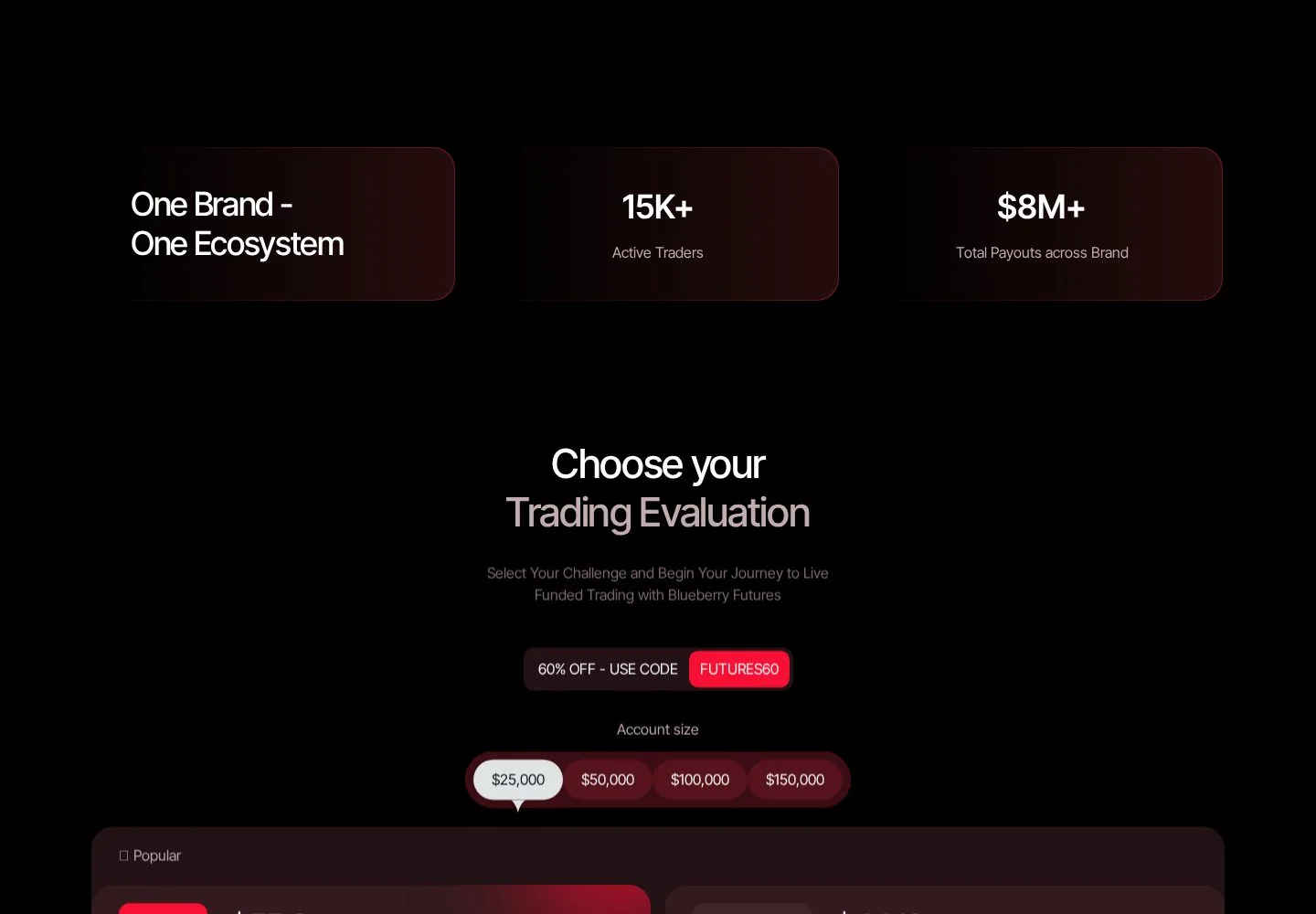
Blueberry Futures offers multiple account sizes across its Ascent and Accelerated challenge types. The core shape is simple: Ascent is the more flexible EOD-drawdown route, while Accelerated is the faster trailing-drawdown route. The account sizes run from smaller retail-style evaluations up to larger simulated allocations.
The current plan page displays recurring monthly challenge pricing and discounts, but this prose will go stale quickly. The comparison tool shows dated evidence for covered accounts. Confirm the exact plan, availability and checkout terms with the provider.
One fairness point matters more than the headline price: the footer says purchases are generally non-refundable after purchase because third-party service commitments are triggered when an account opens. Traders should assume the fee is spent once the account is created.
Payouts and how they get denied
Payouts are the most important part of this review, and Blueberry's payout framework is rule-heavy. The firm says a trader can request the first payout once all eligibility requirements are met. Those include profitable trading days, consistency, enough profit above the required buffer, and completed KYC.
A profitable day only counts if the net profit reaches the firm's stated day threshold. After a payout, the cycle resets and the trader must build a new qualifying cycle. The account is paused while the payout is processed, then trading can resume after approval.
The consistency rule is a major denial point. Accelerated accounts have a tighter single-day profit limit than Ascent accounts, and Blueberry's own example says a withdrawal is denied when the best day represents too much of total profit. In plain English, one huge winning day can delay a payout until the trader grows total profits enough to dilute that day.
The buffer and cap system is another denial point. You can only withdraw funds above the required buffer, and each account size has a maximum withdrawal cap per cycle. This means a trader can be profitable and still unable to withdraw the full headline amount if the required cushion is not present.
KYC can also block payment. Blueberry says it cannot release funds to unverified accounts, and verification may take additional time if manual review is needed. Finally, rule breaches can reduce or cancel payouts: news-window violations can lead to profit deductions, and prohibited strategies can lead to termination.
The public payout record is too young to call settled. That combination supports cautious optimism, not blind trust.
Scaling and longevity
Blueberry Futures advertises a maximum allocation across accounts and says traders can progress to live funded trading after repeated payouts. The brand story is built around long-term sustainability rather than quick withdrawals alone.
The problem is evidence age. The futures product appears new, and the public review base is small. A scaling program becomes meaningful only when many traders have moved through several cycles, received withdrawals, kept accounts active and, where promised, progressed to live capital.
For now, longevity is a conditional positive. The structure is there, the brand story is plausible, and the help-center rules are detailed. Traders should wait for a broader payout record before treating the scaling path as bankable.
Pros and cons
Pros:
- EOD drawdown option for traders who dislike real-time trailing drawdown.
- Clear help-center articles for drawdown, payouts, consistency, news trading and prohibited strategies.
- Broker-backed positioning through the Blueberry ecosystem.
- Futures-only product focus, with permitted exchanges named publicly.
- Competitive advertised profit split on funded accounts.
- KYC process is explained before payout.
Cons:
- The overnight and weekend holding restrictions limit swing-trading strategies, while funded-account news windows can affect trade timing.
- Accelerated uses intraday trailing drawdown. Giving back an unrealized gain can therefore be more restrictive than under the Ascent end-of-day model.
Who it suits
Blueberry Futures suits disciplined futures traders who understand prop-firm rules and want an EOD drawdown route from a recognizable brand ecosystem. It also suits traders who can document their identity, trade listed futures only, and accept a payout process built around consistency and buffers.
It is a poor fit for traders who want a long public payout record, flexible overnight swing trading, unrestricted news trading or aggressive automation. It is also a poor fit for anyone who plans to use one large winner to qualify for a withdrawal, because the consistency rule can delay payment even when the account is profitable.
If your strategy depends on holding into the close, hedging related contracts, trading around data releases, or running latency-sensitive execution, get written confirmation before buying.
Our verdict
Blueberry Futures is a credible but still-young futures prop-firm entry. The documentation is better than average for a new firm, the EOD drawdown option is useful, and the Blueberry brand connection gives it more substance than a generic white-label challenge site.
The caution is the payout record. Public trader feedback is limited and mixed. The firm's own rules create several legitimate reasons a payout can be delayed or denied, and early third-party complaints point to operational friction around activation and support.
Our view: Blueberry Futures is worth monitoring and may be suitable for rule-conscious futures traders who value the Blueberry ecosystem. It should not be treated as a proven low-friction payout firm until the independent trader record becomes broader and more consistent.
FAQ
Q: Is Blueberry Futures a live trading account from day one?
A: No. The firm's own footer describes the Evaluation Challenge as simulated trading. Blueberry says there is a pathway toward live funded trading after repeated payouts, but traders should confirm the current live-account process in the dashboard and terms.
Q: Which drawdown model should I choose?
A: Ascent is the more forgiving route for intraday volatility because drawdown recalculates from end-of-day closed balance. Accelerated is faster to qualify, but the real-time trailing drawdown follows peak live equity and can punish open-profit retracements.
Q: Can I trade news?
A: Blueberry restricts new orders around high-impact news events. Existing positions may be held if opened before the restricted window, and manual closures are allowed, but profits from trades opened during the blackout window can be deducted.
Q: What can stop a payout?
A: The main blockers are insufficient profitable days, failing the consistency rule, failing to keep the required buffer, hitting payout caps, incomplete KYC, and rule breaches such as prohibited strategies or restricted news-window entries.
Q: Does Blueberry Futures have strong trader sentiment?
A: The feedback considered in this review is limited and mixed, including concerns about activation and support. It is too narrow to establish broad, consistently positive sentiment or a settled payout record. The Blueberry brand connection and published rules are separate evidence from the experiences of this futures programme’s traders.
Q: Where should I check current prices?
A: Use the BullTraders comparison tool. Challenge pricing, discounts, reset fees and activation terms change too often for static prose to stay accurate.
Provider documentation
Blueberry Futures official website contains the provider's product pages and legal terms. Match the account, plan and country before applying a rule or advertised price.
Compare tracked prop firm accounts for account fees, rules and payout terms. Not every reviewed firm has accounts in the comparison.