

Atmos Funded Review
Atmos Funded offers instant and challenge accounts with Taurex infrastructure, fast payout claims, and strict trailing drawdown rules.
Review text updated September 13, 2026
Review method: published documents. The text update does not reverify every programme rule.
View tracked accounts and dated terms. Comparison coverage includes only the providers and plans currently collected.
Who is Atmos Funded
Atmos Funded is a broker-backed prop-firm brand that sells simulated trading challenges and instant-funded style accounts. The firm presents itself as part of an Atmos and Taurex ecosystem, with Taurex supplying platform infrastructure and a route for traders to transfer rewards into a live broker account.
The account menu is broad. Atmos offers single-phase challenges, two-phase challenges, instant funding, and a Nova entry product. The firm states that funded trading remains a simulated environment, and that rewards are based on simulated profits rather than direct access to firm capital in live markets.
At a glance
Atmos is best read as a modern, marketing-heavy prop firm with unusually clear help-center documentation and a useful range of account paths. The attraction is simple: low starting options, instant funding for traders who dislike evaluations, frequent payout windows, and a claimed profit share that reaches the upper end of the retail prop-firm market.
The caution is equally clear. The legal disclosure says the service is simulated, customer funds are challenge fees rather than client money, and the company lacks financial-services licensing. The rulebook also contains trailing drawdown locks, anti-gambling restrictions, news-trading limits, commercial EA bans, and style-consistency language. Traders who run aggressive systems need to read the rules before paying.
Eligibility and who can use it
Atmos accepts traders internationally, with important exclusions. Its website lists restricted jurisdictions including the United States, Belgium, North Korea, Russia, Iran, Syria, American Samoa, the Northern Mariana Islands, Palestine, Puerto Rico, Ukraine, the US Virgin Islands, Wallis and Futuna, Yemen, and Zimbabwe.
The service is aimed at forex, metals, indices, oil, and crypto traders, although the exact instrument list is shown inside the trading platform. Traders must be comfortable with identity checks, dashboard-based payout requests, and simulated-account terms.
Firm safety and trust
Atmos has stronger public documentation than many small prop firms. Its help center lays out account types, payout cadence, leverage, drawdown models, and prohibited strategies. Its site also identifies AtmosFunded Ltd as a Cyprus company and Atmos Global Ltd as a Comoros company connected to the simulated trading services.
The safety caveat is material. The footer disclaimer says AtmosFunded Ltd lacks financial-services licensing, does not operate as a broker, dealer, or custodian, and treats paid fees as challenge participation and operational revenue rather than protected client money. It also says trading activity occurs in a fictitious environment using demo accounts.
That does not make Atmos unusual in the prop-firm category, but it limits the protection traders should assume. The practical trust question is payout behavior, rule enforcement, and whether the firm remains solvent enough to keep honoring rewards.
Trading conditions and execution
Atmos says Taurex provides its trading infrastructure, including professional-grade platforms, execution, and operational reliability. The help center lists leverage by asset class: higher on forex, lower on metals and indices, and very low on crypto. The firm points traders to the platform for the full instrument list.
Execution quality remains hard to verify from public sources. There is public marketing around Taurex and platform access, but I did not find independent slippage, spread, rejection, or payout-audit data. Traders using scalping or high-frequency methods should treat the strategy rules as important execution constraints, since Atmos prohibits tick scalping, execution flooding, and other rapid-fire patterns.
Rules and restrictions
Atmos publishes a detailed rule framework. The core restrictions include daily loss limits, maximum drawdown, news-trading restrictions in funded accounts, EA limitations, anti-gambling rules, and breach procedures.
The news rule prohibits opening or closing affected instruments around high-impact events in funded accounts. Profits from violating trades can be removed. Commercial EAs are prohibited, while other EAs are permitted only if they reflect the trader's own strategy and decisions.
The anti-gambling policy is broad. It lists one-sided bets, chasing price through rapid reversals, aggressive averaging, martingale, tick scalping, grid trading, and execution flooding. It also says traders must maintain a consistent trading style across account phases unless Atmos approves a change.
Drawdown is the main risk trap. Some products use trailing drawdown, and the instant-funded account warns that once a payout is requested, drawdown locks at the initial account balance. A trader who withdraws too much can breach immediately by leaving too little buffer.
Plans and cost
Atmos has a wide plan ladder. The public menu includes small entry accounts, standard challenge accounts, plus variants, instant funding, and Nova. The cost shape is typical for retail prop firms: lower fees for small simulated balances, higher one-time fees for larger account sizes, and more expensive instant access than standard evaluation paths.
Exact prices change often, especially during campaigns and site refreshes. The comparison tool shows dated evidence for covered accounts. Confirm the exact plan, availability and checkout terms with the provider.
Payouts and how they get denied
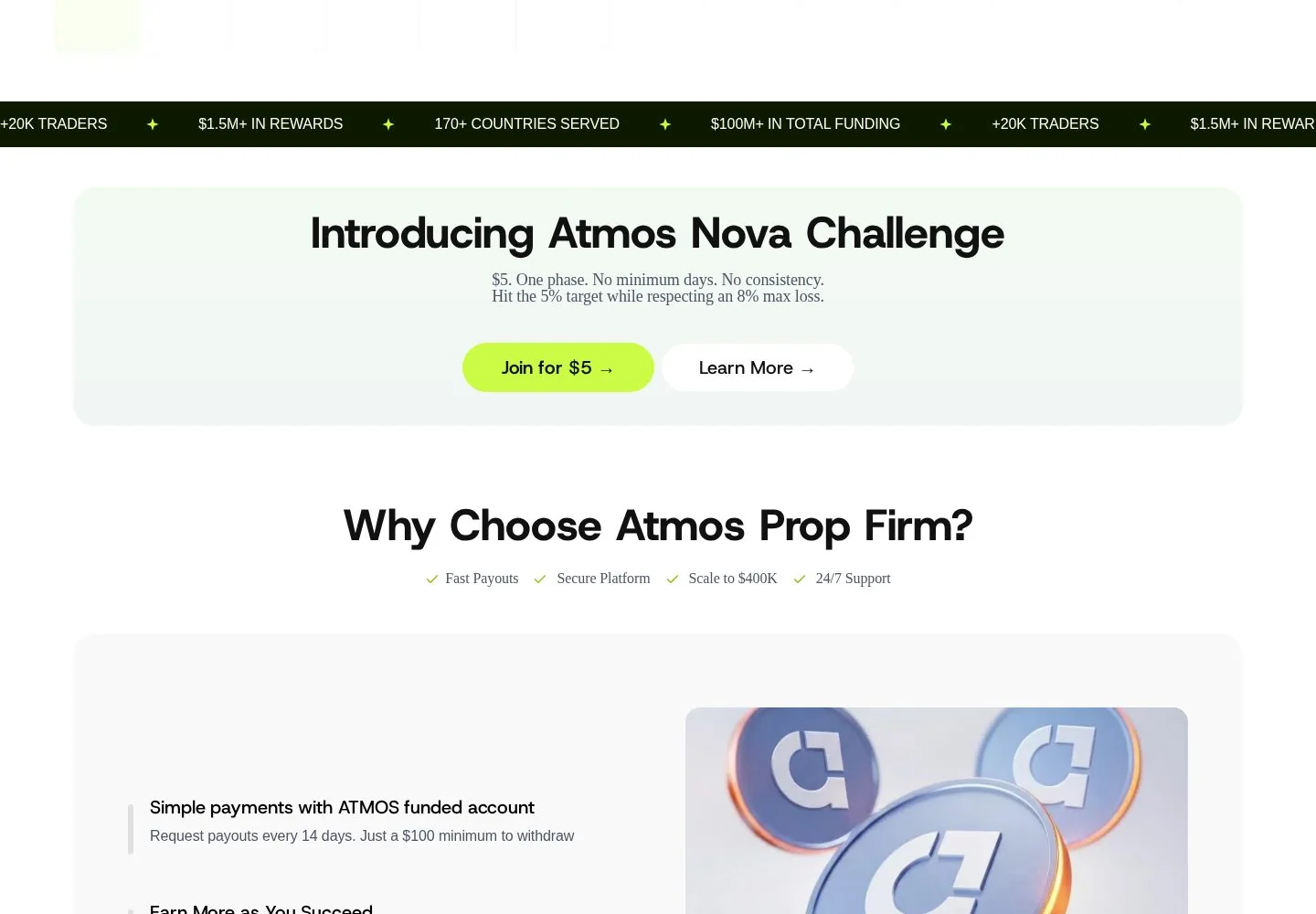
Payouts are the central reason to consider Atmos. The firm says funded traders can request payouts through the dashboard, choose a method, specify the amount, and submit the request. The minimum withdrawal is $100, and payout requests run on a biweekly cycle. Atmos says processing usually takes a few business days after approval, with crypto generally faster than bank transfer.
Denial risk comes from the rules. Profits can be removed for news-trading violations. Anti-gambling violations can lead to profit removal, suspension, or breach. A hard breach closes the account, terminates open trades, and forfeits profits. The instant-funding drawdown lock is especially important because requesting too large a payout can leave the account below its required buffer.
Scaling and longevity
Atmos advertises scaling up to $400,000 and says consistent traders may qualify after staying active for several months, earning multiple payouts, respecting the rules, and achieving a meaningful profit threshold. The structure rewards traders who withdraw carefully and preserve account buffer.
Limitations
- Funded-stage news restrictions and the commercial-EA prohibition can exclude strategies that otherwise appear suitable for a simulated account.
- The instant-funded drawdown lock can leave too little loss buffer after a payout request. Withdrawal size and the remaining balance need to be considered together.
Who it suits
Atmos is for traders who want a documented prop-firm rulebook, a choice between evaluation and instant-style accounts, and a broker-backed ecosystem that can transfer rewards into Taurex. It suits discretionary traders who can avoid news events, keep account buffers, and trade in a consistent style.
It is a poor fit for traders who rely on martingale, grid systems, commercial EAs, rapid scalping, aggressive averaging, or frequent news-event trading. It is also unsuitable for anyone who expects regulated brokerage protections or direct access to live firm capital.
Our verdict
Atmos Funded is credible enough to research seriously and rule-heavy enough to approach carefully. The firm has a polished public presence, transparent help-center articles, multiple account paths, and some encouraging payout reports. The Taurex connection also gives the platform story more substance than a bare white-label prop site.
The risk sits in the legal and operational fine print. Trading is simulated, regulator protection is limited, and the firm has broad discretion around style, gambling behavior, news trades, and breaches. The payout setup looks attractive for disciplined traders, but the drawdown lock makes careless withdrawals dangerous.
Our view: Atmos is worth comparing for traders who value instant access or flexible challenge types, provided they read the current rules before buying and treat every payout as something earned only after compliance review.
FAQ
Q: Is Atmos Funded a live trading prop firm?
A: Atmos says customer trading takes place in a simulated environment using demo accounts. Rewards are tied to simulated profits, and traders can transfer payouts to a Taurex account if they choose.
Q: Does Atmos offer instant funding?
A: Yes. Atmos has an instant-funded account path with no evaluation phase. It uses risk-management rules, including trailing drawdown and a consistency rule.
Q: How often can traders request payouts?
A: Atmos says funded traders can request payouts on a biweekly cycle, with a minimum withdrawal amount and dashboard-based requests.
Q: What rules are most likely to cause problems?
A: The key risks are drawdown breaches, news trading around high-impact events, commercial EA use, anti-gambling violations, and abrupt changes in trading style.
Q: Is Atmos available to US traders?
A: The website lists the United States as a restricted jurisdiction, so US residents should treat the service as unavailable unless Atmos changes its policy.
Q: Should aggressive scalpers use Atmos?
A: Aggressive scalpers should be cautious. Atmos lists tick scalping, execution flooding, rapid reversals, and several other high-frequency or high-risk patterns as prohibited practices.
Provider documentation
Atmos Funded official website contains the provider's product pages and legal terms. Match the account, plan and country before applying a rule or advertised price.
Compare tracked prop firm accounts for account fees, rules and payout terms. Not every reviewed firm has accounts in the comparison.