


Webull
Webull is a polished multi-asset broker with strong mobile and improving futures tools, best for retail traders rather than prop-firm execution desks.
Review text updated September 13, 2026
Review method: published documents. Text updates are separate from the dated profile evidence; current features and account terms have not all been reverified.
Scores
Overall3.3/ 5
- Charting3.7 / 5
- Execution3.1 / 5
- Ease of use4.0 / 5
- Mobile4.5 / 5
- Automation2.2 / 5
- Data quality3.3 / 5
- Value3.8 / 5
- Support2.1 / 5
Pros
- Free platform access across desktop, web and mobile
- Broad product coverage including stocks, ETFs, options, OTC stocks, fixed income, crypto and futures
- Webull Futures is a CFTC-registered FCM and NFA member
- Futures page advertises ladder trading, paper trading, advanced order types and free real-time CME market data after account opening
- Desktop platform now includes TPO, customizable tick charts, TurboTrader Futures and custom indicators
- Mobile app is a core product rather than an afterthought
Cons
- Not a standard platform for futures prop-firm evaluations or funded accounts
- Public futures pricing capture did not expose exact per-contract commission amounts in the original editorial review, only tiered commission language
- Payment-for-order-flow model and lack of direct-access routing are drawbacks for some active stock day traders
- Automation is thin compared with NinjaTrader, TradeStation or Interactive Brokers APIs
- Futures ecosystem is young compared with Tradovate, NinjaTrader, Rithmic and Quantower
What is Webull
Webull is a multi-asset retail brokerage platform operated in the United States by Webull Financial LLC for securities and Webull Futures LLC for futures, under Webull Corporation. The U.S. site positions it as a self-directed broker for stocks, ETFs, options, OTC stocks, fixed income, crypto and futures, with access through desktop, web and mobile platforms.
At a glance
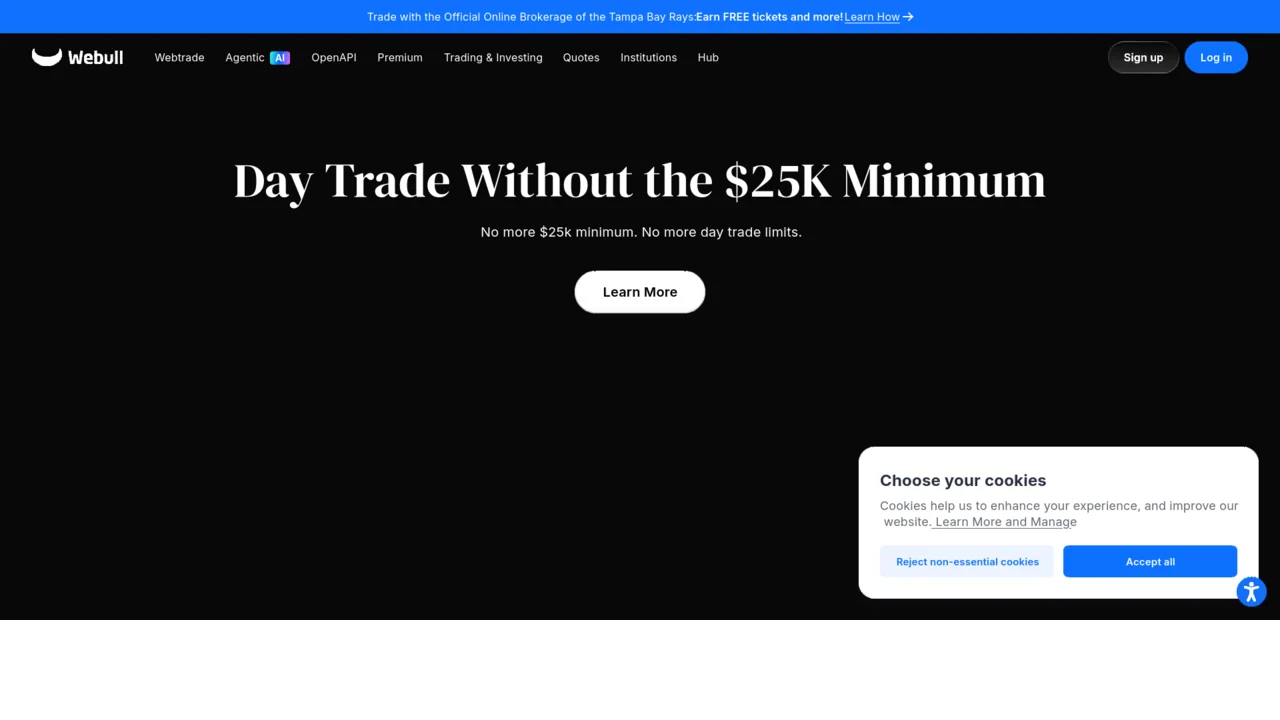
Webull is a strong retail broker interface and a credible casual futures on-ramp, rather than a first-choice execution platform for funded futures prop traders. The charting, mobile app, paper trading and free platform access are real advantages. Its limits show up around prop-firm compatibility, specialist order-flow tooling, automation depth and support sentiment.
Markets, instruments, and who can use it
Webull covers U.S. stocks, ETFs, fractional shares, equity and index options, OTC stocks, fixed income products, money market funds, crypto and futures, depending on account type, jurisdiction and approval. Webull Futures LLC says it supports key futures contracts on CME and Coinbase, including micro equity index, metals, energy, FX, rates, agricultural and crypto futures. Platform access is broad: Webull lists Desktop, WebTrade and mobile apps, with footer download options for Mac, Windows, Linux Ubuntu, iOS and Android.
For a U.S. retail trader who wants one account interface for stocks, options and small futures exposure, Webull is a sensible candidate. For a trader trying to pass a futures prop-firm evaluation at Apex Trader Funding, Topstep, Take Profit Trader, Bulenox, My Funded Futures or similar firms, Webull is the wrong gate because those firms generally route through their supported stacks such as Tradovate, NinjaTrader, Rithmic, Quantower, TradingView or proprietary dashboards.
Charting and analysis
Webull's charting is much stronger than the old stereotype of mobile-first zero-commission brokers. The current platform page advertises Webull Desktop with real-time insights, a TPO indicator, customizable tick charts, TurboTrader Futures, voice quotes and customizable indicators. The homepage also calls out advanced charting tools with pattern recognition, drawings, indicators and technical signals.
That gives a discretionary trader enough to scan, annotate, monitor and place basic trades. It still sits below specialist charting environments for users who build elaborate multi-monitor order-flow workspaces, custom market-profile layouts or institutional feed comparisons. In community search results, traders often describe Webull Desktop as clean and capable, while still naming TradingView or thinkorswim when they want deeper charting libraries.
Order execution and order flow
For futures, Webull now advertises ladder trading. A ladder is a price-column order-entry tool, similar in purpose to a DOM, or depth-of-market ladder, where bids, offers and orders are placed against price levels. Webull describes its ladder trading as a real-time view of bid and ask prices across multiple price levels with fast order placement and control over entries, exits and scaling. It also advertises advanced order types and paper trading with full intraday support.
That is a meaningful improvement for a broker that was historically associated with stocks and options. The caveat is ecosystem depth. A futures execution specialist expects a mature DOM, hotkeys, bracket and OCO workflows, reliable flatten and reverse behavior, order-flow add-ons, footprint charts, exchange-routing transparency and a long community record under fast-market stress. Webull shows some of the surface area, but its public documentation and community footprint do not yet put it in the same lane as NinjaTrader, Tradovate or Sierra Chart for active funded futures execution.
Automation and backtesting
Webull has a Script Editor, and the help page describes it as a tool for customizing and sharing indicators using a simplified language inspired by TradingView's Pine Script. That is useful for indicator customization and visual decision support. It is a different category from a full strategy automation environment.
The public materials reviewed in the original editorial review did not show a mature futures backtester, broker-hosted strategy engine, exchange-simulation model, walk-forward tooling or documented production automation stack comparable with NinjaScript, EasyLanguage, Interactive Brokers API workflows or TradingView strategy testing. r/algotrading search results also point toward Webull API discussions that historically relied on unofficial or reverse-engineered access. For serious systematic trading, treat Webull as a manual and semi-discretionary platform unless you have a current, documented API agreement from Webull itself.
Data, feeds, and connectivity
Webull's futures page states that a brokerage account gives access to free real-time CME market data. Its homepage also advertises Level 2 Quotes and NBBO for stock-market depth. For the mainstream retail user, that is a clean value proposition: account, quote data, charts and trading screens live in one broker interface.
For a futures prop trader, the feed question works differently. Prop firms usually supply or prescribe the connection, such as Tradovate, Rithmic, CQG or a proprietary dashboard. Webull is its own broker and FCM path, so the trader is not choosing a portable front end to connect to a funded-account data feed. The public pages reviewed here also did not document independent feed choices, tick-history depth, or historical data policies at the level that a futures scalper or strategy tester would want before relying on it for high-volume work.
Pricing decoded
The headline platform price is Free. Webull's pricing page says it offers transparent prices with 0 commission trades and no deposit minimums, while explaining that the company earns from stock loans, interest on free credit balances, margin interest and payment for order flow. It also states that Webull does not charge commissions for U.S.-listed stocks, ETFs and options, while regulatory fees, exchange fees, option contract fees and other pass-through charges may apply.
Futures pricing needs a caveat. The futures page says Webull uses tiered commissions and that Premium members can receive tiered discounts on futures commissions. In this research run, the detailed commission modal behind View Commission Details did not expose a readable per-contract table through the available browser capture, so exact futures commission amounts are marked as not stated rather than invented. Exchange, NFA and regulatory fees should be assumed additional unless Webull's live fee schedule says otherwise at account opening.
Worked break-even example, illustrative: a NinjaTrader-style lease-versus-lifetime calculation does not apply because Webull's platform access is Free rather than sold as a separate desktop license. If two traders each place the same monthly number of MES round turns on Webull, the fixed platform-license difference between month one and month twelve remains zero. The break-even question instead becomes whether a Premium futures commission discount, if available to that user, saves more than any Premium cost or eligibility requirement. Because the captured Webull page did not state the exact futures commission tiers, that break-even should be calculated from the live account fee schedule before funding.
Prop-firm compatibility
Webull is not compatible with the usual futures prop-firm workflow we cover at prop-firm reviews. The decisive issue is structural: Webull is a broker and FCM, while evaluation firms usually issue accounts through their own approved execution stacks. In practice, firms such as Apex Trader Funding, Topstep, Take Profit Trader, Bulenox and My Funded Futures typically steer traders toward Tradovate, NinjaTrader, Rithmic, Quantower, TradingView or proprietary dashboards, depending on the firm and program.
That means Webull may be useful for a trader's personal brokerage account, watchlists or cross-market monitoring, while still being unusable for the funded account itself. Readers comparing prop-firm reviews should verify the platform list inside the specific firm review and the firm's current checkout flow before assuming any broker can connect.
Mobile and cross-device
Mobile is one of Webull's real strengths. The platform page treats the Webull Mobile App as a primary interface, and the homepage says users can trade and manage investments across mobile, web and desktop. That gives Webull a better cross-device story than desktop-first futures platforms that offer mobile only as a monitoring companion.
The trade-off is parity. A phone is useful for monitoring positions, managing a swing trade, checking options chains or handling a simple order. It is a poor primary surface for fast futures scalping, multi-chart execution, hotkey work or serious order-flow analysis. Webull's mobile strength helps its broader brokerage audience more than it solves the desk-bound prop futures use case.
Should you run it on a VPS
A VPS is rarely the first spending priority for Webull. The platform already supports desktop, web and mobile, and the main use case is direct broker access rather than a prop account that must keep a Windows execution platform online near the exchange. A VPS can still make sense if you run Webull Desktop on a remote workstation for continuity, but futures prop traders should reserve that decision for platforms and firms that actually support their funded account. See VPS reviews for the broader hosting checklist.
Who it suits
Webull is for retail traders who want a polished broker with free platform access, strong mobile coverage and enough charting to trade stocks, options, ETFs, crypto and smaller futures positions from one account family. It also suits a futures-curious trader who wants micro contracts, paper trading and a simple account path before committing to a specialist platform.
It is a poor fit for traders whose main goal is a futures prop-firm evaluation, because Webull is outside the normal funded-account platform list. It is also a poor fit for automation-first traders, direct-access equity scalpers and order-flow specialists who need a deep DOM, third-party add-ons, documented APIs and a long record of execution behavior under stress.
Our verdict
Webull deserves respect as a modern retail broker interface. The product coverage is broad, the platform access is free, mobile is strong, and Webull Futures has added features that matter, including ladder trading, futures paper trading, real-time CME data access and a wider futures contract list.
For BullTraders' core reader, the gating facts cost it. Webull is a broker, not a portable futures prop-firm front end. Use it for a personal retail account if the product mix fits. Choose a prop-compatible specialist platform for funded futures work.
FAQ
Is Webull good for futures trading?
Webull is adequate for a retail trader who wants accessible futures exposure, especially micro contracts and a cross-device broker account. It is less compelling for high-frequency discretionary futures execution, order-flow trading or funded-account prop trading.
Does Webull work with futures prop firms?
No, Webull is not a standard supported platform for the futures prop firms BullTraders covers. Those firms typically use Tradovate, NinjaTrader, Rithmic, Quantower, TradingView or their own dashboards.
Is Webull really free?
The platform access headline is Free, and Webull advertises no commissions for U.S.-listed stocks, ETFs and options. The real cost picture still includes regulatory fees, exchange fees, options contract charges where applicable, margin interest, payment-for-order-flow economics and futures commissions or exchange fees.
Does Webull have automation?
Webull has a Script Editor for custom indicators, using a simplified language inspired by Pine Script. That is useful for chart studies, but it is not the same as a mature automated futures strategy environment with institutional-grade backtesting.
What devices does Webull support?
Webull supports desktop, web and mobile. The site lists Mac, Windows, Linux Ubuntu, App Store and Google Play access points.
What is the main risk with Webull?
For active futures traders, the main risk is choosing it for a job it is not built to do: prop-firm execution and advanced automation.
Provider documentation
Webull official website contains the provider's product pages and legal terms. Match the account, plan and country before applying a rule or advertised price.
Provider pricing
Webull pricing and available products should be checked for the exact account or hosting configuration. Compare the full charge, billing period and optional services before purchase.