


Trading 212
Trading 212 is a commission-free UK investing app for stocks, ETFs, ISAs and CFDs, built for beginners and long-term investors, not futures day traders.
Review text updated September 13, 2026
Review method: published documents. This provider review may cover products beyond CFDs; account availability and protections depend on the contracting entity.
Ratings
Overall2.9/ 5
- Charting2.0 / 5
- Execution2.0 / 5
- Ease of use4.7 / 5
- Mobile4.6 / 5
- Automation1.5 / 5
- Data quality3.0 / 5
- Value3.5 / 5
- Support3.5 / 5
This assessment uses our trading-platform criteria. It is not a separate rating of the broker’s regulation or client protection.
Trustpilot
4.6 / 5
97,113 customer reviews
Observed 2026-07-10
Read the Trustpilot profileA separate customer-review signal, not part of our score or a measure of trading performance.
Worth considering
- Truly commission-free investing in 13,000+ global stocks and ETFs, with fractional shares from £1
- One of the most polished, beginner-friendly investing apps available (4.7 iOS / 4.6 Android)
- AutoInvest 'Pies' automate recurring, self-rebalancing portfolios
- Tax-wrapped Stocks & Shares ISA and SIPP for UK investors, plus competitive daily interest on uninvested cash
- Strong safety framing: FCA/BaFin/CySEC/ASIC regulation, FSCS protection up to £120,000, and shares custodied at Interactive Brokers
Consider the limitations
- Not a futures platform and not prop-firm compatible: no DOM/SuperDOM, one-click scalping, hotkeys, or order-flow/footprint tools
- CFDs use a market-maker model where cost is baked into dynamic spreads; community reports of wide spreads and slippage
- No native desktop application, the 'desktop' experience is just the browser web platform
- No automation depth: no scripting language, no strategy builder, and no backtester
- Product is optimized for buy-and-hold retail investors, so active and algorithmic traders will hit its ceiling quickly
What is Trading 212
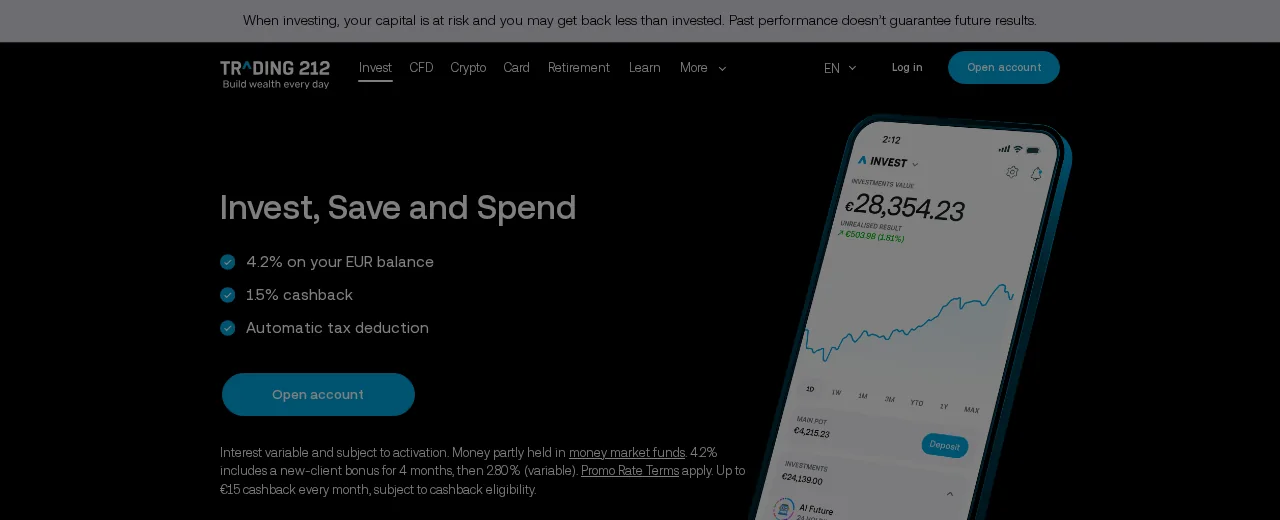
Trading 212 is a commission-free retail investing app and broker, not an active-futures execution platform. It is operated by Trading 212 Group Limited, headquartered in London and regulated by the FCA in the UK, with sister entities under BaFin (Germany), CySEC (Cyprus) and ASIC (Australia). The business traces back to 2004 in Sofia, Bulgaria, where founders Ivan Ashminov and Borislav Nedialkov built the firm that became Avus Capital Group before rebranding to Trading 212 and moving its center of gravity to London. Today it serves over five million funded accounts across three products: commission-free Invest (stocks and ETFs, including tax-wrapped ISA and SIPP accounts), leveraged CFDs, and a spending card, all delivered through a web platform and a mobile app rather than a desktop trading terminal.
At a glance
If you are a beginner or a buy-and-hold investor who wants to own stocks and ETFs cheaply inside a clean app, Trading 212 is one of the best experiences available, commission-free, fractional shares from £1, a tax-efficient ISA and SIPP, and daily interest on idle cash. If you are an active futures day trader who lives on a DOM and hotkeys, this is the wrong tool entirely: there is no futures execution surface, no order-flow tooling, no desktop application, and no automation. The CFD product exists, but it runs on a dealer-set spread model that serious traders treat with caution. Read it as an investing platform first and a light CFD broker second.
Markets, instruments, and who can use it
Here is the early gate. Trading 212 trades stocks and ETFs (over 13,000 instruments across NYSE, NASDAQ, LSE, Xetra, Euronext and more), and it offers leveraged CFDs on stocks, indices, commodities and more than 180 forex pairs. It does not offer exchange-traded futures as a first-class product the way NinjaTrader, Tradovate or Sierra Chart do; the small 'Futures' line in its fee table refers to a minimum trade value, not a CME futures execution suite.
Device support is Web plus Mobile (iOS and Android); there is no native desktop trading application, and what users call the 'desktop' version is the browser web platform. If you trade CME or Eurex futures for a funded prop account, or you need a native Windows execution platform with a SuperDOM (a price-ladder order-entry window), this is not for you, and you can stop here. If you want to invest in shares and ETFs or dabble in leveraged CFDs from a phone or browser, keep reading.
Charting and analysis
Charting is functional, not a workbench. On both the app and web platform you get standard candlestick and line charts, a normal set of built-in indicators, and basic drawing tools across common timeframes. That is enough to eyeball a trend or place a considered entry as an investor. It is thin for a serious technical analyst: there are no multi-chart grid layouts, no custom studies or user-defined indicators, and no rendering depth comparable to TradingView or a desktop analysis platform. Traders who care about detailed technicals routinely chart elsewhere (frequently TradingView) and simply execute in Trading 212, which tells you where charting sits in the product's priorities.
Order execution and order flow
This is the daily core for an active trader, and it is where Trading 212 is deliberately minimal. On the Invest side, execution is a simple market or limit order: pick a company, choose an amount, and get your shares, with those orders ultimately routed through Interactive Brokers, which custodies client shares. It is clean and fast for investing, but there is no DOM or SuperDOM (the ladder view that shows resting bids and offers at each price and lets you click a level to send an order), no one-click scalping, no bracket or OCO order presets aimed at active trading, no hotkeys, and no footprint or order-flow tooling (the charts that show buying versus selling pressure inside each bar).
On the CFD side, the important structural fact is that Trading 212 acts as the counterparty and quotes its own prices; the cost of trading is embedded in a dynamic spread that widens with market conditions, plus overnight interest on positions held past 22:00 GMT. Community threads specifically flag wide spreads and slippage in fast markets. For a reader who judges a platform by its fill workflow, this is an investing app, and it will feel bare.
Automation and backtesting
Trading 212's only automation is AutoInvest, its 'Pies' feature: you build a basket of stocks and ETFs, set target weights and a recurring deposit, and the app buys and rebalances toward those targets on a schedule. For a long-term investor that is genuinely useful and well executed. For an algorithmic or systematic trader it is not automation in any meaningful sense: there is no scripting language (no Pine Script, no NinjaScript C#, no EasyLanguage), no visual strategy builder, and, most importantly, no backtester. The honest read is that there is nothing here to backtest a strategy against historical data, so anyone building or validating a trading system will need a different platform. The absence of a backtester is not a hidden flaw the vendor buries; the product simply is not aimed at that user.
Data, feeds, and connectivity
For the investing product, market data and execution ride on Interactive Brokers' infrastructure, which is a serious, established backbone, and shares are held at IBKR in ring-fenced, segregated accounts. That is reassuring for reliability and custody on the Invest side. For CFDs, pricing is dealer-quoted by Trading 212 itself rather than delivered from an independent exchange feed, which is why spread and slippage complaints cluster on that product. There is no connection to the professional futures feeds an active trader expects, Rithmic, CQG or IQFeed, and no broker-agnostic connectivity, because the platform is closed: you trade Trading 212's own book and data, not a third-party feed. There is no prop-firm-supplied data or connection scenario here, because the platform is not part of the prop-firm ecosystem.
Pricing decoded
The headline is simple and it is the frontmatter figure: Free. Trading 212 charges zero trading commission and zero custody fee on the Invest product, and free deposits and withdrawals. The costs that do exist are these, from the company's own terms and fees page: an FX fee of 0.5% applied only to the result when you close a position in a currency other than your account currency; dynamic CFD spreads that vary with market conditions; and CFD overnight interest on positions held past 22:00 GMT, which can be positive or negative. There is no license tier, no monthly subscription, and no per-contract commission schedule, because this is a free-to-use broker that monetizes through spreads, FX fees, share lending and interest on cash rather than a platform license.
Because there is no lease-versus-lifetime license to break even on, the usual worked example does not apply the way it would for NinjaTrader. The comparison that matters here is Invest cost versus CFD cost. Illustrative example: an investor who buys £2,000 of a US stock in a GBP account pays £0 commission on entry and, if the position gains £200 and is closed, pays roughly 0.5% of the £200 result as an FX fee, about £1 (illustrative).
A CFD trader running the same idea with leverage pays no commission but crosses a spread on entry and exit and pays overnight interest each night the position is open; on a fast-moving, frequently-traded book those embedded costs dwarf the investor's £1 FX fee. The honest cost picture: for buy-and-hold investing this is close to free; for active leveraged CFD trading the true cost is real, variable, and largely invisible until you total up the spreads.
Prop-firm compatibility
This is the decisive gate for our reader, and the answer is direct: Trading 212 is not prop-firm compatible. None of the futures prop firms we cover let you trade through Trading 212, because Trading 212 is a closed retail broker with its own book, not a platform that accepts a third-party funded account or a Rithmic/CQG connection. There is no direct-connection path and no firm-dashboard integration. A funded futures trader looking for the platform behind an evaluation should look at our prop-firm reviews and the platforms those firms actually support (NinjaTrader, Tradovate, and similar), not here. If prop-firm access is your requirement, Trading 212 fails the gate before any of its other merits matter.
Mobile and cross-device
Mobile is not an afterthought here; it is the main event. The iOS app carries a 4.7 rating (188k ratings) and the Android app a 4.6 (417k ratings), both shown on Trading 212's own site, and the mobile experience has full parity with the web platform because the product was designed mobile-first. The web platform mirrors it for anyone who prefers a larger screen. What is genuinely missing is a native desktop trading terminal; power users who want a dedicated Windows or Mac execution app will not find one. For the platform's actual audience, investors managing a portfolio and topping up a Pie, that omission barely registers. For a desk-bound day trader it would be disqualifying, which again points to who this is really for.
Should you run it on a VPS
Skip it. The classic VPS case is a desktop execution platform tied to a funded account that must stay connected around the clock, and Trading 212 is neither desktop software nor an automated-strategy host: it is a web and mobile app with no algo engine to keep running. There is nothing here that benefits from a always-on virtual server. If you are researching VPS hosting for a genuine desktop trading setup, that belongs to platforms like NinjaTrader, see our VPS reviews for where it actually matters.
Who it suits
It is for the beginner and the long-term investor: someone who wants to own stocks and ETFs cheaply, automate contributions through Pies, use a UK ISA or SIPP, and manage it all from a phone. It is a strong fit there. It is not for the budget futures trader hunting a cheap execution platform, it does not trade futures. It is not for the order-flow or automation optimizer, there is no DOM, no scripting, and no backtester. And it is not for the trader whose market or workflow needs a native desktop terminal or a prop-firm connection. If any of those describe you, the gating facts rule it out regardless of how polished the app is.
Our verdict
Judged as what it is, Trading 212 is an excellent commission-free investing app with a class-leading beginner experience, real cost transparency on the Invest side, with custody and protection arrangements that must be checked for the contracting entity and product. Judged against our reader, the active futures prop trader, it fails the gates that matter most: no futures, no prop-firm compatibility, no desktop execution surface, no DOM or order-flow tools, and no automation or backtesting.
Those absences are not bugs; they reflect a product built for a different person. What the gating facts cost it is the entire execution and automation dimension our weights prize most, which is why it lands where it does for this collection even as it would score far higher on a general investing-app leaderboard. Right tool, wrong reader, and the honest framing is to point futures traders elsewhere while telling investors it is one of the best in its lane.
FAQ
Can I trade futures on Trading 212? No. Trading 212 offers stocks, ETFs and CFDs (on stocks, indices, commodities and forex), but not exchange-traded futures. Active futures traders should look at dedicated futures platforms and our prop-firm reviews.
Is Trading 212 really free? Investing in stocks and ETFs is commission-free with no custody fee and free deposits and withdrawals. Costs that apply are a 0.5% FX fee on the result of trades in a non-account currency, dynamic CFD spreads, and CFD overnight interest. That is the same 'Free' figure shown in this review's headline.
How does Trading 212 make money if trading is free? Mainly through CFD spreads, the 0.5% FX fee, interest earned on client cash, and share-lending income, rather than per-trade commissions on the Invest product.
Is Trading 212 safe and regulated? It is regulated by the FCA in the UK (and BaFin, CySEC and ASIC via sister entities). UK client funds are protected by the FSCS up to £120,000, and client shares are custodied at Interactive Brokers in segregated accounts.
Is Trading 212 good for CFD day trading? It is workable but community sentiment is cautious. CFDs use a market-maker model with dealer-set, dynamic spreads, and traders report wide spreads and slippage in fast markets. Serious active traders generally prefer platforms with a DOM and independent order flow.
Does Trading 212 work with prop firms? No. It is a closed retail broker with no third-party or prop-firm connectivity, so you cannot trade a funded futures evaluation through it.
Provider documentation
Trading 212 official website contains the provider's product pages and legal terms. Match the account, plan and country before applying a rule or advertised price.
Provider pricing
Trading 212 pricing and available products should be checked for the exact account or hosting configuration. Compare the full charge, billing period and optional services before purchase.
Text updates, score evidence and customer-review observations have separate dates. This document review does not report a demo, execution or withdrawal test.