


SaxoTrader
SaxoTrader is a polished multi-asset broker platform with serious global market access, strong mobile support, and weak prop-firm fit.
Review text updated September 13, 2026
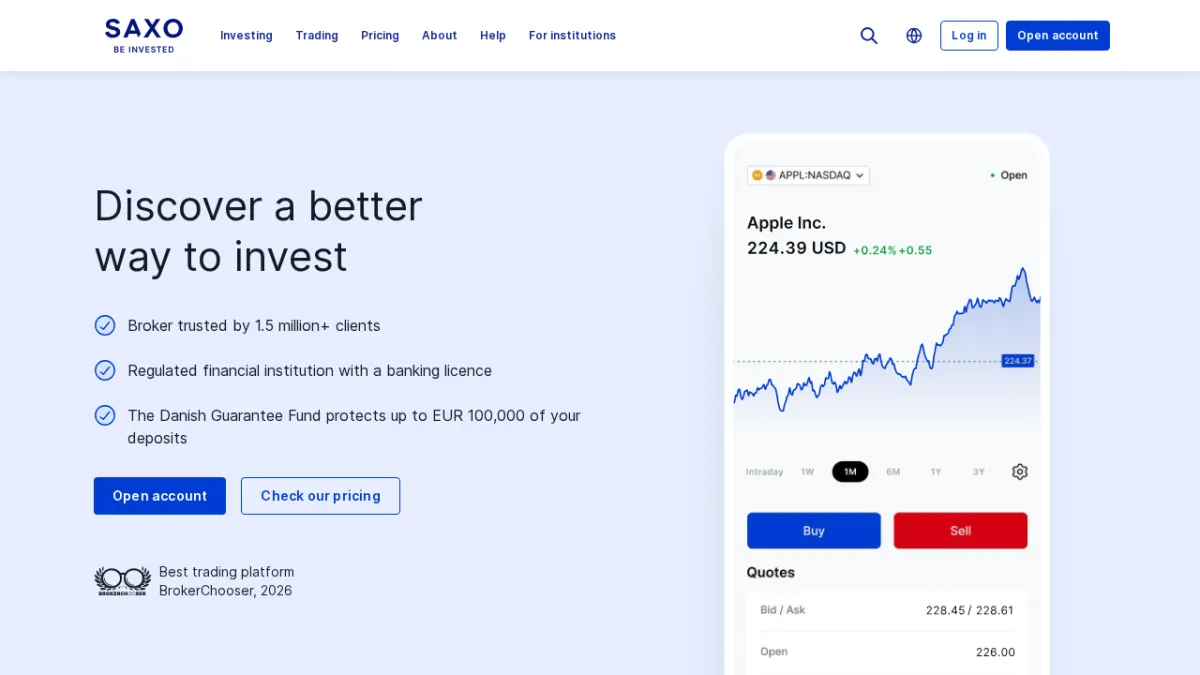
Review method: published documents. This provider review may cover products beyond CFDs; account availability and protections depend on the contracting entity.
Ratings
Overall3.4/ 5
- Charting3.8 / 5
- Execution3.4 / 5
- Ease of use3.6 / 5
- Mobile4.2 / 5
- Automation2.6 / 5
- Data quality3.8 / 5
- Value3.0 / 5
- Support3.7 / 5
This assessment uses our trading-platform criteria. It is not a separate rating of the broker’s regulation or client protection.
Trustpilot
3.7 / 5
8,593 customer reviews
Observed 2026-07-09
Read the Trustpilot profileA separate customer-review signal, not part of our score or a measure of trading performance.
Worth considering
- Very broad instrument coverage, including futures, listed options, forex, CFDs, stocks, ETFs, mutual funds, bonds, and commodities
- Regulated Danish bank structure with more than 30 years of operating history and a large global client base
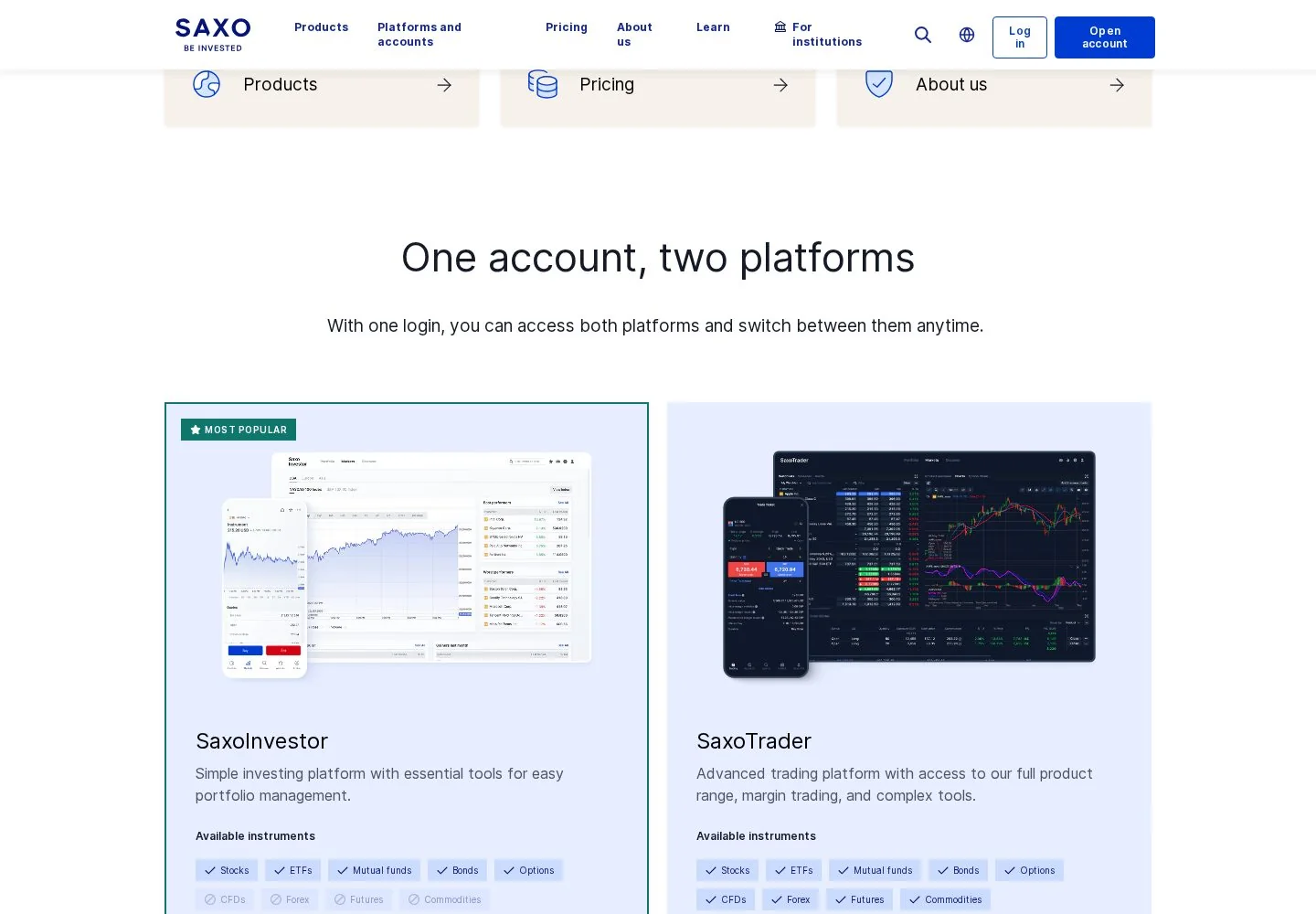
- SaxoTrader runs across web, desktop, and mobile with one account login
- Strong charting for a broker platform, including 85+ indicators, drawing tools, and chart trading
- Depth Trader, time and sales, spread trading, trailing stops, stop-limit orders, and account-wide risk controls are available for futures users
- OpenAPI gives developers a documented route for custom tools and data access
Consider the limitations
- Poor fit for the active futures prop-firm reader because major funded-account firms rarely support Saxo as the execution platform
- Futures commissions are expensive for high-turnover micro-contract trading unless the trader qualifies for premium tiers
- Native automation and backtesting are thin compared with NinjaTrader, TradeStation, MultiCharts, or Sierra Chart workflows
- Market data costs and exchange subscriptions still matter, despite the platform fee headline
- Community coverage is smaller than the ecosystem around futures-first platforms
What is Saxo
SaxoTrader is the advanced trading platform from Saxo Bank A/S, the Danish online trading and investment bank founded in Copenhagen in 1992. Saxo began with online trading in Europe, now serves more than 1.5 million clients, and offers access to more than 71,000 instruments through SaxoTrader and SaxoInvestor. In 2026, Bank J. Safra Sarasin completed a majority acquisition of Saxo and later announced a deal to acquire the remaining stake, with Saxo continuing as the operating trading brand.
At a glance
SaxoTrader is a polished, serious multi-asset broker platform, and it shines when the job is global market access from one regulated account. It is a weaker fit for our core reader, the active futures prop trader, because Saxo is a broker venue rather than the execution platform used by most funded-account programs. Futures traders get real tools here, including Depth Trader, chart trading, spread orders, and time and sales, but the cost profile and prop-firm support are the gating issues.
Markets, instruments, and who can use it
SaxoTrader covers futures, listed options, forex, CFDs, commodities, stocks, ETFs, mutual funds, and bonds. Saxo says futures coverage includes more than 250 contracts across more than 25 exchanges, including indices, energy, metals, rates, and micro and E-mini contracts. Platform access is broad: SaxoTrader runs on web, desktop, and mobile, with Saxo saying the same account also opens SaxoInvestor for simpler investing.
For a futures scalper who needs a funded-account login from Apex, Topstep, Take Profit Trader, MyFundedFutures, or similar firms, Saxo is usually the wrong gate. Those firms tend to support Tradovate, NinjaTrader, Rithmic, CQG, TradingView, or a firm dashboard. Saxo is for traders using their own broker account, especially outside the narrow US futures-prop lane.
Charting and analysis
SaxoTrader's charting is strong for a broker platform. The platform page lists more than 85 technical indicators, annotation and drawing tools, chart trading, integrated trade signals, and an earnings calendar. Multi-asset watchlists, screeners, dashboards, performance reporting, margin monitors, and risk tools sit around the charting layer, which makes Saxo feel more like a portfolio trading workstation than a pure chart viewer.
The limitation is depth for futures order-flow specialists. Saxo has Depth Trader and time and sales, yet it does not present the same ecosystem of footprints, custom order-flow studies, third-party add-ons, and trader-built templates that surround Sierra Chart, NinjaTrader, or Bookmap. A discretionary swing trader or multi-asset analyst will likely find enough here. A tick-by-tick ES scalper may want a platform built around the ladder first.
Order execution and order flow
SaxoTrader supports market, limit, stop, stop-limit, trailing-stop, and algo order types, plus smart order routing that Saxo says scans multiple venues for price and liquidity. For futures, Saxo lists chart trading, calendar spread orders from a single ticket, a cancel-all-orders tool, account shield, Depth Trader for placing and managing orders against the Level 2 order book, and time and sales for execution prints.
Depth Trader is the important futures feature. It is Saxo's order-book trading view, similar in purpose to a DOM, where a trader can place and manage orders around bid and ask depth. The catch is that Saxo is still a broad broker platform. It lacks the prop-firm-native workflow and specialist ladder culture around NinjaTrader SuperDOM, Tradovate, and Sierra Chart. Execution is credible for a Saxo brokerage account, while the active funded-account trader will hit compatibility before fill workflow.
Automation and backtesting
Saxo's automation story is API-led. Saxo Developer documents OpenAPI with reference docs, an explorer, app management, streaming, chart services, orders, portfolio, account history, and sample-application material. That is useful for a developer who wants to build custom dashboards, data tools, or execution integrations around a live Saxo account.
The retail platform itself does not advertise a native strategy language, strategy builder, or backtesting engine comparable to NinjaScript, EasyLanguage, Pine Script, or Sierra Chart ACSIL. That matters. API access can be powerful, but it moves testing, simulation, deployment, error handling, and monitoring into your own code. Treat Saxo automation as a broker API for competent developers, rather than an integrated strategy lab.
Data, feeds, and connectivity
Saxo says SaxoTrader offers Level 1 and Level 2 data subscriptions across more than 40 exchanges. On the futures page, the Depth Trader feature requires a data subscription and uses the Level 2 order book in real time. Time and sales data comes from the primary venue or BATS depending on the subscription.
The practical cost picture depends on what you trade. A stocks and ETF investor may use delayed or included data in some cases. A futures day trader needs the relevant real-time exchange feed, and those exchange fees sit outside the platform-fee headline. Unlike a prop-firm setup, where the firm often supplies the connection and data entitlement through Rithmic, Tradovate, CQG, or its own platform, Saxo puts the trader inside Saxo's brokerage and subscription model.
Pricing decoded
The entry headline is simple: Saxo advertises No platform or inactivity fees, and the homepage also states no minimum initial funding. That does not mean futures trading is cheap. Saxo's futures commission table says commissions apply per contract and per trade, including buy, sell, or expiry, and exclude exchange fees listed under contract specifications.
Here is the worked example. Suppose an illustrative active trader does 1,000 round-turns in a month in a USD futures contract. A round-turn means one entry and one exit, so that is 2,000 contract-side trades. At the Classic rate of USD 3 per contract-side, the commission is USD 6,000 before exchange and regulatory fees. At the VIP rate of USD 1 per contract-side, the same activity is USD 2,000 before exchange and regulatory fees.
The difference is USD 4,000 for that month, but Saxo's public table does not define a simple paid license upgrade that buys the lower tier; it is an account-tier and activity relationship. The break-even therefore is not a license break-even. It is a qualification question: if your futures volume is high enough to qualify for better Saxo pricing, ask Saxo for the exact tier terms before trading size.
For micro futures, the commission math is especially important. A small contract with a small tick value can become uneconomic if the per-contract ticket is too high. This is where futures-specialist brokers often beat multi-asset banks.
Prop-firm compatibility
This is the decisive gate for BullTraders readers. Saxo is a broker and platform suite, not a standard funded-futures evaluation platform. We did not find Saxo listed as a normal direct execution choice for the major futures prop firms we cover, such as Topstep, Apex Trader Funding, Take Profit Trader, MyFundedFutures, or Earn2Trade-style Rithmic and CQG workflows.
That means Saxo is generally a poor fit if you are comparing firms in our prop-firm reviews and need a login that works inside a funded challenge. A typical prop-firm trader will be routed to Tradovate, NinjaTrader, Rithmic, CQG, TradingView where supported, or the firm's own dashboard. Use Saxo when you want to trade your own Saxo brokerage account. Use the firm-supported platform when the funded account is the product.
Mobile and cross-device
Mobile is one of Saxo's stronger areas. Saxo says the SaxoTrader mobile app gives access to positions, continuous background price alerts, and all the features of the browser version in an intuitive layout. Saxo also promotes Google Play and Apple App Store ratings on the platform page, which fits its broader retail-broker audience.
For futures day trading, mobile should be treated as monitoring and emergency management rather than the primary cockpit. It is useful for checking positions, alerts, margin, and orders away from the desk. The trader who lives in a ladder, hotkeys, multiple charts, and order-flow tools will still want desktop or web on a proper workstation.
Should you run it on a VPS
A VPS is less central for SaxoTrader than for a Windows-only desktop platform running an always-on strategy, but it can still make sense for API users or traders who need stable connectivity away from their home internet. If your Saxo workflow is discretionary web, desktop, and mobile trading, a VPS is optional. If you build OpenAPI automation or need a machine close to your monitoring stack, compare hosts through our VPS reviews and treat latency, uptime, and maintenance access as the real criteria.
Who it suits
Saxo is for the trader who wants a serious global broker account across futures, options, forex, CFDs, stocks, ETFs, bonds, and funds. It is also for the technically capable user who wants API access without giving up a regulated broker relationship. It makes sense for multi-asset traders, globally mobile investors, and futures traders who trade their own account and value breadth more than the cheapest micro-futures commission.
Saxo should be avoided by funded-futures traders who need compatibility with a specific prop firm. It is also a weak match for the order-flow purist who wants a deep third-party add-on ecosystem, footprints, custom DOM tooling, and platform-native backtesting. Very active micro-futures scalpers should model commissions before assuming the headline platform fee tells the whole story.
Our verdict
SaxoTrader is a good broker platform and a compromised futures-prop platform. Its strengths are real: broad market access, regulated-bank infrastructure, cross-device access, solid charting, API documentation, and credible futures order tools. Its costs are also real: futures commissions can be heavy for active contract turnover, exchange data is separate, and the platform sits outside the normal funded-account routes.
For BullTraders readers, the verdict is straightforward. Saxo is worth considering for a personal multi-asset brokerage account. It is rarely the right starting point for a futures prop-firm challenge.
FAQ
Is Saxo good for futures trading?
Saxo can trade futures and offers futures-specific tools such as Depth Trader, spread trading, chart trading, time and sales, stop-limit orders, trailing stops, and account-level risk controls. It is better viewed as a multi-asset broker that supports futures than as a futures-only platform.
Does Saxo work with futures prop firms?
Generally, no. Major futures prop firms usually support Tradovate, NinjaTrader, Rithmic, CQG, TradingView where available, or their own dashboards. Saxo is a broker account platform, so compatibility is the main blocker for funded-account traders.
What does Saxo cost to start?
There is no single all-in starting price. Budget separately for trading commissions, exchange fees, market-data subscriptions and the funding required by your account and chosen instruments. Saxo's futures commission schedule charges per contract for each trade and excludes exchange fees. It also says prices vary by country of residence and that exact pricing is available in the platform's trade tickets. A platform-fee headline is not the total cost of trading.
Does Saxo have good charting?
Yes, for a broker platform. Saxo lists more than 85 indicators, drawing tools, chart trading, watchlists, screeners, trade signals, and integrated calendars. Futures order-flow specialists may still prefer platforms with deeper custom study and footprint ecosystems.
Can you automate trading with Saxo?
Saxo offers OpenAPI for developers, including streaming, chart, order, portfolio, and account-history services. The retail SaxoTrader platform does not advertise a built-in strategy builder or backtester on the level of NinjaTrader, TradeStation, TradingView, or Sierra Chart.
Is Saxo better than NinjaTrader or Tradovate?
For global multi-asset brokerage, Saxo has the broader product set. For funded futures accounts, futures ladders, prop-firm compatibility, and futures-specialist workflows, NinjaTrader and Tradovate are usually the better fit.
Provider documentation
SaxoTrader official website contains the provider's product pages and legal terms. Match the account, plan and country before applying a rule or advertised price.
Provider pricing
SaxoTrader pricing and available products should be checked for the exact account or hosting configuration. Compare the full charge, billing period and optional services before purchase.
Text updates, score evidence and customer-review observations have separate dates. This document review does not report a demo, execution or withdrawal test.