


eToro
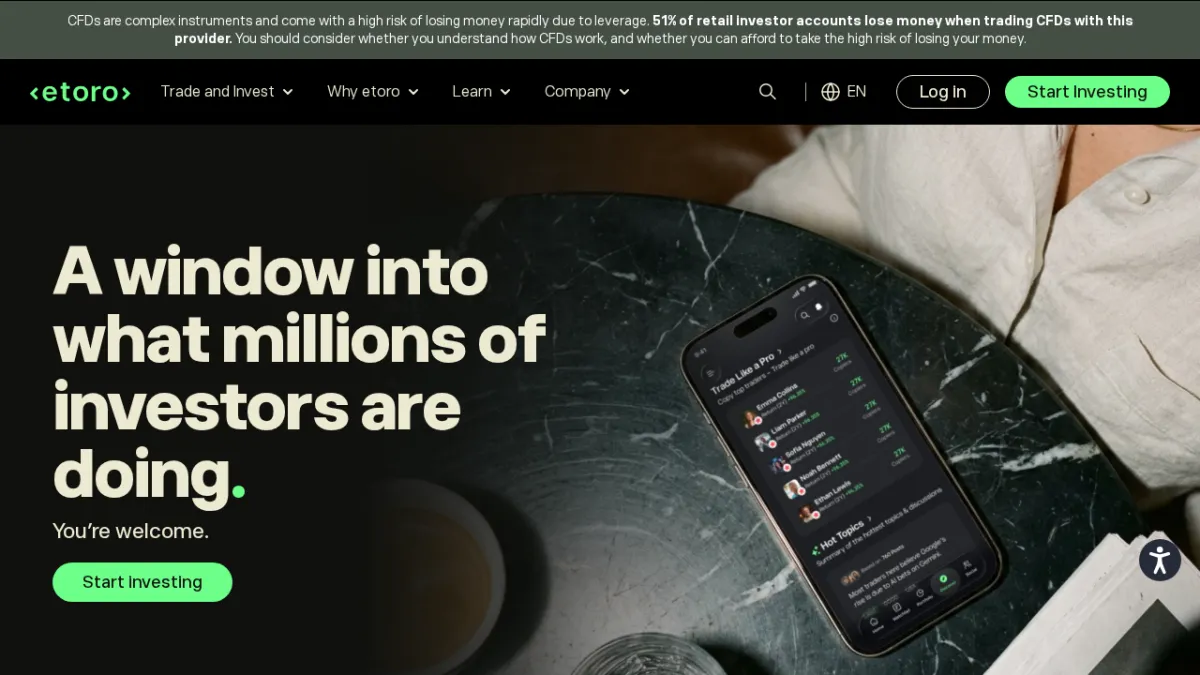
eToro is a clean social-investing broker for stocks, ETFs, crypto and CFDs, but it is a poor fit for futures prop execution.
Review text updated September 13, 2026
Review method: published documents. This provider review may cover products beyond CFDs; account availability and protections depend on the contracting entity.
Ratings
Overall2.9/ 5
- Charting2.8 / 5
- Execution1.6 / 5
- Ease of use4.4 / 5
- Mobile4.5 / 5
- Automation2.6 / 5
- Data quality2.6 / 5
- Value3.2 / 5
- Support3.0 / 5
This assessment uses our trading-platform criteria. It is not a separate rating of the broker’s regulation or client protection.
Trustpilot
4.1 / 5
31,783 customer reviews
Observed 2026-07-07
Read the Trustpilot profileA separate customer-review signal, not part of our score or a measure of trading performance.
Worth considering
- Very approachable web and mobile interface for casual investors
- Strong social and copy-trading identity compared with standard brokers
- Broad multi-asset coverage including stocks, ETFs, crypto, commodities, currencies and CFDs where permitted
- Free demo account with virtual funds for practice
- Public API documentation now exists for market data, order management and portfolio tools
Consider the limitations
- Poor fit for active futures prop traders because it has no futures ladder, DOM, Rithmic or CQG funded-account workflow
- No serious order-flow suite such as footprint charts, market depth tools or futures-specific bracket workflow
- Spreads, conversion charges, withdrawal fees and CFD overnight costs can make the real cost higher than the headline account price
- Charting is useful for casual analysis but thin versus TradingView, NinjaTrader or Sierra Chart
What is eToro
eToro is a Nasdaq-listed multi-asset broker and social-investing platform founded in 2007. It combines stock, ETF, crypto, CFD and copy-trading access in a web and mobile interface, with the operating entity depending on the client region.
At a glance
eToro is a polished consumer broker, and that matters more than its charting or execution depth. It works best for investors who want simple access to stocks, ETFs, crypto and CopyTrader. It is a weak match for the BullTraders reader who needs a funded futures account, a DOM, bracket execution and reliable fast-market order workflow.
Markets, instruments, and who can use it
eToro advertises access to thousands of assets, including stocks, ETFs, cryptoassets, commodities, currencies and more, with regional differences in what is available. The platform runs on web and mobile, with iOS and Android app links published by eToro. It is not a native Windows futures workstation, and it does not give an active CME futures trader the usual Rithmic, CQG, Tradovate or NinjaTrader route into a funded account.
That gate matters. If you trade stocks, ETFs, crypto or CFDs casually, eToro may fit. If you trade E-mini or Micro E-mini futures through a prop firm, this is the wrong tool.
Charting and analysis
eToro includes ProCharts, which the company describes as a professional-grade technical analysis tool for comparing instruments and time frames. That gives a casual trader the basics: charts, indicators, comparisons and enough visual context to manage a portfolio or a simple swing-trade idea.
The limitation is depth. A serious futures analyst will miss the specialist workflow found in TradingView, Sierra Chart, NinjaTrader or Bookmap: deep multi-chart layouts, custom studies, order-flow overlays, replay depth and institutional-grade chart control. eToro charting is good enough to support the broker experience. It is thin as a research terminal.
Order execution and order flow
eToro supports practical retail order controls such as stop loss and take profit. Those terms mean automated exit orders that close a position when a loss limit or profit target is reached. For a casual investor, that is enough to make the platform usable.
For active futures execution, the missing pieces are decisive. There is no futures DOM, meaning a depth-of-market ladder for placing and managing orders at specific price levels. There is no SuperDOM-style scalping workflow, no footprint charting, no native order-flow suite, and no funded-futures connection model. The platform is built around broker account trading, portfolio positions and social investing, rather than rapid ladder execution.
Automation and backtesting
eToro now publishes a developer portal with API documentation covering algorithmic trading, real-time market data, order management, watchlists, balances, social feeds and WebSocket topics. That is a meaningful improvement for developers who want to build dashboards, portfolio tools or execution scripts around an eToro account.
It still is not the same category as NinjaScript, EasyLanguage, Pine Script or a mature desktop strategy environment. The public documentation points to order placement and data access, but not to a deeply integrated historical backtester with tick replay, slippage modelling, walk-forward testing and broker-grade simulation controls. Treat eToro automation as an account API for builders, not as a complete strategy-development workstation.
Data, feeds, and connectivity
eToro says its API can stream real-time price data across crypto, stocks, ETFs, commodities and more. The main platform also advertises cross-device trading, analyst ratings, forecasts and portfolio tools. For the intended investor audience, the data layer is convenient because it is bundled into the broker experience.
The futures-prop problem remains. eToro is not a Rithmic or CQG front end, and it is not the place where a funded futures firm normally supplies exchange data and a trading connection. That changes the cost math completely: with NinjaTrader, Tradovate or Quantower, the firm often controls the connection and data entitlement. With eToro, you are inside eToro's brokerage environment.
Pricing decoded
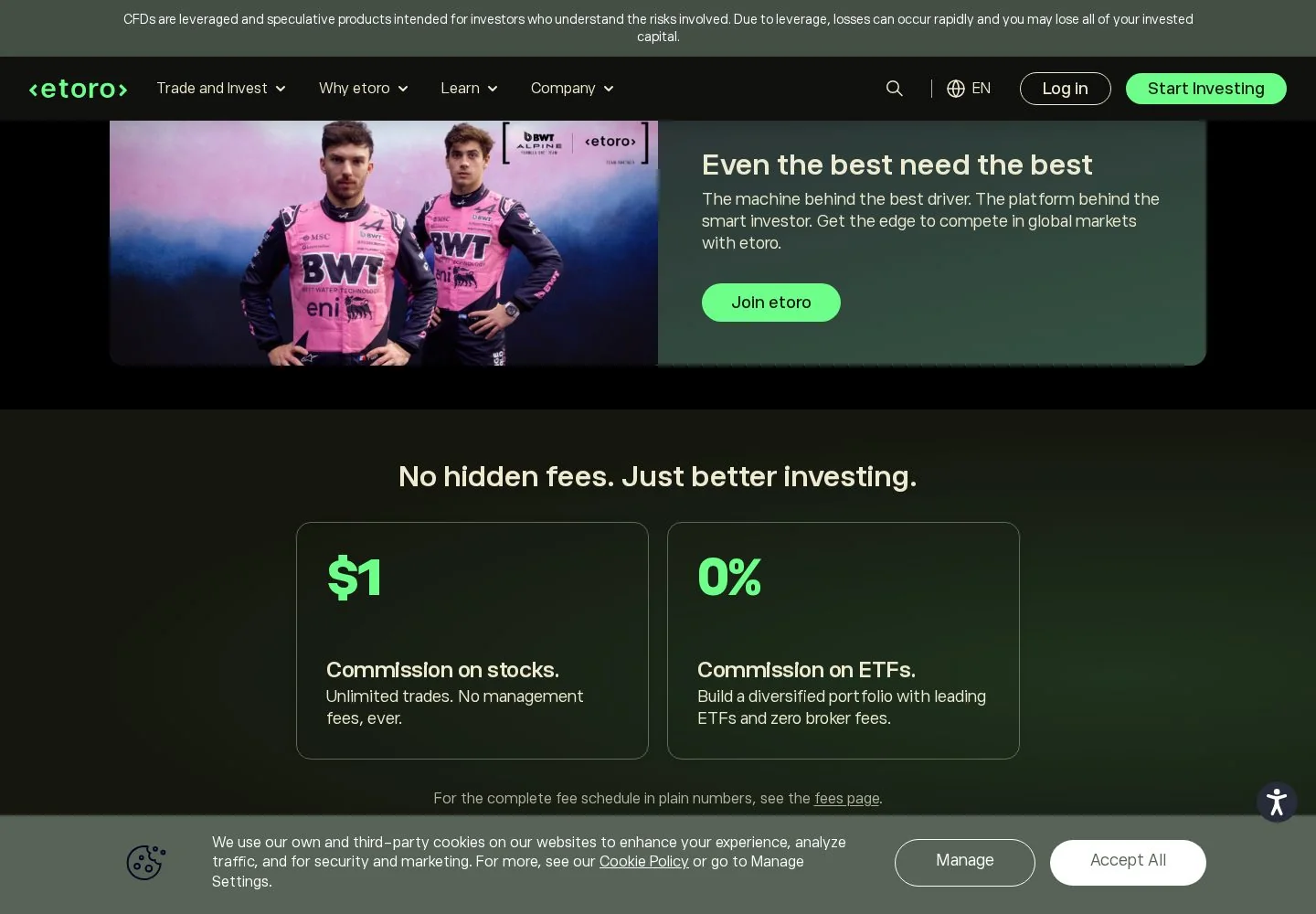
eToro's headline entry price is Free. Crypto pricing is separately advertised by eToro as a percentage fee on cryptoasset positions, and CFDs can carry overnight charges.
Here is the honest cost picture. There is no futures-platform license to lease or buy, and there are no per-contract CME commissions because this is not a futures prop execution platform. An illustrative stock example in a country where the stock fee is $1 per opening or closing event: a trader who opens and closes 20 stock positions in a month would create 40 commission events, or $40 before spreads, conversion costs and any withdrawal fee. In a country or exchange bucket where the event fee is $2, the same activity becomes $80 before those other costs.
There is no lifetime-license break-even like NinjaTrader because eToro has no equivalent lifetime futures license. The break-even decision is therefore practical, not mathematical: if your cost driver is frequent intraday execution, spreads, conversion and overnight CFD charges matter more than the free account headline. If your use is occasional investing or copy trading, the free entry point is genuinely accessible.
Prop-firm compatibility
eToro is not compatible with the active futures prop-firm workflow we cover at prop-firm reviews. Firms built around CME futures accounts typically route traders through platforms such as NinjaTrader, Tradovate, Quantower, Rithmic, ATAS or firm-specific dashboards. eToro is a broker account, not a funded-futures front end.
That means no direct Apex Trader Funding, Topstep, Take Profit Trader or similar futures-prop account connection through eToro. A trader comparing Apex Trader Funding or Topstep should treat eToro as outside the decision set.
Mobile and cross-device
Mobile is one of eToro's real strengths. The company has offered mobile apps for years, links directly to the App Store and Google Play, and markets seamless switching between web and mobile. For a casual investor checking a portfolio, closing a position or copying a trader, that is valuable.
Mobile parity is less compelling for futures scalping. A funded trader managing fast-moving futures positions usually wants a stable desktop, hotkeys, a ladder, attached brackets and a low-latency connection. eToro mobile is a broker app, not a pocket version of a futures execution workstation.
Should you run it on a VPS
A VPS is unnecessary for normal eToro use because the platform is web and mobile based. The classic VPS case is a Windows desktop futures platform running an automated strategy or maintaining a stable prop-firm connection. eToro does not fit that pattern for most users. If you are evaluating VPS options for a real futures stack, start with VPS reviews instead.
Who it suits
eToro is for the investor who wants a simple broker, a broad asset menu, a clean app and social features such as CopyTrader. It also suits the curious beginner who wants a demo account and a less intimidating interface than a professional futures terminal.
It is a poor fit for the budget futures prop trader, because there is no funded-futures connection and no CME execution workflow. It is also a poor fit for an order-flow optimizer who needs footprint charts, depth tools and ladder execution. Developers may find the API interesting, but systematic traders who need mature backtesting and detailed simulation should compare dedicated algo-capable platforms first.
Our verdict
eToro earns respect as a consumer broker and social-investing platform. It is easy to use, mobile-first in the practical sense, globally recognised and much friendlier to beginners than most trading software.
The same design choices make it weak for BullTraders' core reader. A funded futures trader needs fast execution controls, data-feed choice, a firm-supported connection and platform depth. eToro offers a clean brokerage experience instead. Use it for the job it was built for, and do not force it into the futures prop-trading lane.
FAQ
Q: Is eToro good for futures prop trading?
A: No. eToro is a broker and social-investing platform. It does not provide the normal funded-futures workflow through Rithmic, CQG, Tradovate, NinjaTrader or a prop-firm dashboard.
Q: Does eToro have a desktop platform?
A: eToro is primarily web and mobile. That is convenient for investors, but it is different from a native Windows futures workstation with a DOM and hotkey execution.
Q: What can I trade on eToro?
A: Availability depends on region, but eToro advertises stocks, ETFs, cryptoassets, commodities, currencies and more. Some markets may be offered as CFDs depending on jurisdiction.
Q: Does eToro support automated trading?
A: eToro publishes API documentation for market data, order management, portfolios, watchlists and related functions. That helps developers, but it is not a full professional backtesting and strategy-development suite.
Q: Why do traders complain about eToro costs if the account is free?
A: The account can be free to open and maintain, while real trading costs can still come from spreads, stock event fees in some countries, currency conversion, withdrawal fees and CFD overnight charges.
Q: Who is eToro best for?
A: It is best for casual investors who value a simple app, broad asset access and copy-trading features. Active futures traders should use a platform built for futures execution.
Provider documentation
eToro official website contains the provider's product pages and legal terms. Match the account, plan and country before applying a rule or advertised price.
Provider pricing
eToro pricing and available products should be checked for the exact account or hosting configuration. Compare the full charge, billing period and optional services before purchase.
Text updates, score evidence and customer-review observations have separate dates. This document review does not report a demo, execution or withdrawal test.